

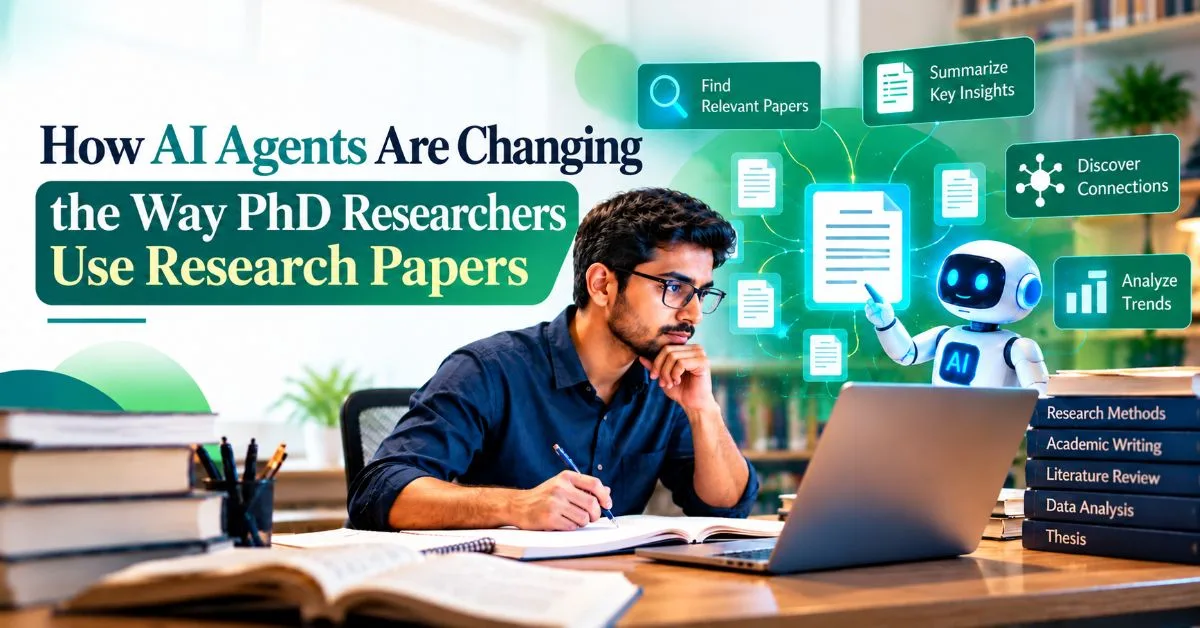
Research papers are an important part of every PhD journey. Researchers read papers to understand existing work, learn research methods, identify gaps, and develop new ideas. However, a research paper is usually a static document. Researchers still need to find the code, understand the methodology, set up the required tools, and test the method themselves.
A recent development called Paper2Agent is exploring a new way of working with research papers. The system can turn research papers and their associated code into interactive AI agents that researchers can communicate with and use for research tasks. Published in Nature on September 16, 2026.
For PhD researchers, this development could make some research methods easier to explore, reproduce, and apply to new research problems.
What Happened?
Researchers introduced Paper2Agent, a system that transforms research papers into interactive AI agents.
Instead of only reading a paper, researchers can use its available code, tools, and workflows through an AI agent using natural-language instructions.
The approach was tested with research papers in computational biology and related fields to explore how published research methods could be made easier to use and reuse.
This matter because many research methods can be difficult to reproduce or apply without additional technical work.
What Is Paper2Agent?
Paper2Agent is a research system that uses AI agents to work with the information and tools associated with scientific papers.
A traditional research paper usually contains:
- Research objectives
- Methodology
- Results
- Data or datasets
- Code or algorithms
- Experimental details
- References
Paper2Agent attempts to connect these elements with AI-powered tools.
In simple terms, the idea is: Research Paper + Code + Research Tools → Interactive AI Agent
A researcher can then interact with the agent to explore the research method and, where supported, use the associated tools.
This does not mean that every research paper can automatically become a working AI agent. The availability and quality of code, data, documentation, and software environments can affect the result.
How Does It Work?
The process involves several steps.
1. Finding the Research Resources
The system identifies the research paper and its associated code or repository.
2. Setting Up the Environment
Research software often requires specific packages, libraries, and dependencies. The system attempts to prepare the required environment.
3. Understanding the Research Method
The paper and its code are reviewed to identify the research methods and computational workflows used.
4. Creating Research Tools
The identified methods can be turned into tools that an AI agent can access.
5. Testing the Tools
The tools can then be tested against reference results to check whether they behave as expected.
6. Creating the AI Agent
The final tools can be made available through an AI-agent interface so researchers can interact with them using natural language.
The Paper2Agent study used the Model Context Protocol (MCP) to connect AI agents with research tools and resources.
Why Does This Matter for PhD Researchers?
For PhD researchers, the important point is not simply that AI agents can answer questions. They may also help researchers work with research methods and tools, rather than only summarize papers.
Researchers often spend significant time understanding an existing method before reproducing or extending it. An interactive research agent could make some of these early steps easier.
For example, a machine learning researcher studying a specific model could interact with the associated tools instead of only reading the methodology section. This could support learning, experimentation, and further research development.
How Can PhD Researchers Use AI Agents?

1. Understanding Research Papers
Researchers can use AI agents to explore complex research papers by asking questions such as:
- What is the main research problem?
- What methodology was used?
- What dataset was used?
- What are the main findings?
- What limitations were reported?
This can make the initial exploration of a paper easier. However, AI-generated explanations should always be checked against the original paper.
2. Exploring Research Methods
Reading about a research method does not always make it easy to understand how it works in practice.
A paper-based AI agent could provide an interactive way to explore supported methods and tools. This may be especially useful for researchers entering a new research area.
3. Reproducing Previous Research
Reproducibility is an important part of scientific research. Researchers may want to check whether previous findings can be reproduced using available code and data.
Paper2Agent explored this by validating research tools against reference implementations and reported results. Its case studies demonstrated reproduction of results from the original papers.
For PhD researchers, this could provide another way to examine existing research before extending it.
4. Working with New Data
Researchers may want to apply a published computational method to a different dataset.
When the required code and tools are available, an AI agent could help researchers interact with the method and explore its application to new data.
However, this does not guarantee successful results. Researchers still need to design experiments and evaluate the outcomes.
5. Supporting Cross-Disciplinary Research
PhD researchers often work across fields such as AI, healthcare, environmental science, finance, remote sensing, and bioinformatics.
Learning methods from another field can take considerable time. Interactive research agents could help researchers explore unfamiliar methods and understand how they may be applied.
Can AI Agents Help with Literature Review?
AI agents can support literature reviews, but researchers should remain responsible for evaluating the literature.
AI agents may help researchers:
- Understand individual papers
- Explore research methodologies
- Identify important concepts
- Compare research approaches
- Examine how a method was implemented
- Explore connections between research methods
However, a literature review involves more than simply collecting summaries.
A good literature review requires researchers to critically examine evidence, compare findings, identify disagreements, understand limitations, and determine research gaps.
Therefore, AI should be treated as a research support tool, not as a replacement for critical thinking.
Can AI Agents Help Find Research Gaps?
AI tools can help researchers explore large amounts of literature, but identifying a meaningful research gap still requires human judgment.
For example, an AI system may identify that several papers use similar methodologies.
The researcher still needs to determine:
- What has already been studied?
- What remains unanswered?
- Is the gap scientifically meaningful?
- Can it be investigated?
- What methodology would be appropriate?
- What contribution could the research make?
Therefore, AI can support the discovery process, while the researcher remains responsible for evaluating the research gap.
What Are the Benefits for PhD Researchers?
AI agents could provide several potential benefits.
Faster Research Exploration
Researchers may be able to explore complex papers and associated methods more quickly.
Easier Access to Research Methods
Interactive tools may make some published methods easier to understand and experiment with.
Support for Reproducibility
Paper-based agents can potentially help researchers reproduce computational workflows when the necessary resources are available.
Better Research Learning
Students can ask questions and explore unfamiliar methods interactively.
Support for New Experiments
Researchers may be able to investigate how existing methods behave with new data.
Cross-Disciplinary Research Support
AI agents may help researchers explore methods outside their primary research area.
What Are the Limitations?
AI agents are not a replacement for research expertise.
There are several limitations that PhD researchers should understand.
Not Every Paper Can Become an AI Agent
A paper may not provide usable code, complete documentation, or accessible datasets.
The Paper2Agent researchers reported challenges involving missing code or data, software dependencies, and scripts that could not always be generalized.
AI Can Make Mistakes
An AI agent may misunderstand a research method or produce an incorrect explanation.
Researchers should verify important information using the original source.
Results Still Need Validation
Even when an AI agent produces an output, researchers should check whether the result is scientifically reasonable.
Software Can Become Outdated
Research code depends on software packages and computing environments. Changes in these dependencies can affect whether an old research workflow continues to work.
Human Judgment Is Still Necessary
Choosing a research question, evaluating evidence, designing experiments, and drawing scientific conclusions remain important responsibilities of the researcher.
How Should PhD Researchers Use AI Responsibly?
AI can be useful in research when it is used carefully. PhD researchers should follow a few basic practices:
Read the original paper.
Do not depend only on AI-generated explanations.
Verify important information.
Check facts, methods, citations, and results against reliable sources.
Validate research outputs.
Do not assume that AI-generated results are automatically correct.
Protect research data.
Avoid uploading confidential, unpublished, or sensitive data without checking privacy and institutional requirements.
Follow university and journal policies.
Check the rules of your university and the AI guidelines of journals before using AI in research or submitting a manuscript.
Keep human judgment at the centre.
AI can support research activities, but scientific responsibility remains with the researcher.
Can AI Agents Replace PhD Researchers?
No. AI agents are research-support tools, not replacements for PhD researchers.
They may help with tasks such as understanding papers, exploring methods, running supported workflows, and analysing information.
However, researchers still need to:
- Define research questions
- Evaluate evidence
- Design experiments
- Interpret results
- Identify meaningful research gaps
- Make scientific decisions
- Take responsibility for their research
The Paper2Agent research emphasizes a human-in-the-loop approach, where researchers remain responsible for choosing research directions and evaluating evidence.
What Could This Mean for the Future of Research Papers?
Traditionally, research papers are something researchers read. AI agents suggest another possibility: papers could become resources that researchers can interact with.
Instead of only reading how a method works, researchers could potentially interact with the method, use associated tools, and explore research workflows.
This could make published research more interactive and reusable.
In the future, research papers may increasingly connect: Knowledge + Code + Data + Tools + AI Agents
Such a model could support more interactive and reproducible research. However, its effectiveness will still depend on the quality and accessibility of the underlying research resources.
What Should PhD Researchers Remember?
Paper2Agent shows how AI is moving beyond simple question-answering toward more interactive research support.
For PhD researchers, the key points are:
- AI agents can make some research papers more interactive.
- They may help explore complex research methods.
- They can potentially support reproducibility and experimentation.
- They can assist with literature exploration.
- They cannot replace critical research thinking.
- Original papers and research evidence should always be checked.
- AI-generated results should be independently validated.
Key Takeaway
AI agents could change the way PhD researchers interact with research papers. Instead of using papers only as sources of information, researchers may increasingly use AI-powered systems to explore their methods, tools, and workflows.
For PhD scholars, the goal should not be to let AI do the research. Instead, AI agents can act as research assistants that support learning, experimentation, and method exploration while human judgment remains at the centre of scientific research.
Source: Miao et al., Reimagining research papers as interactive and reliable AI agents, Nature, September 16, 2026.
Read the original research — Nature