
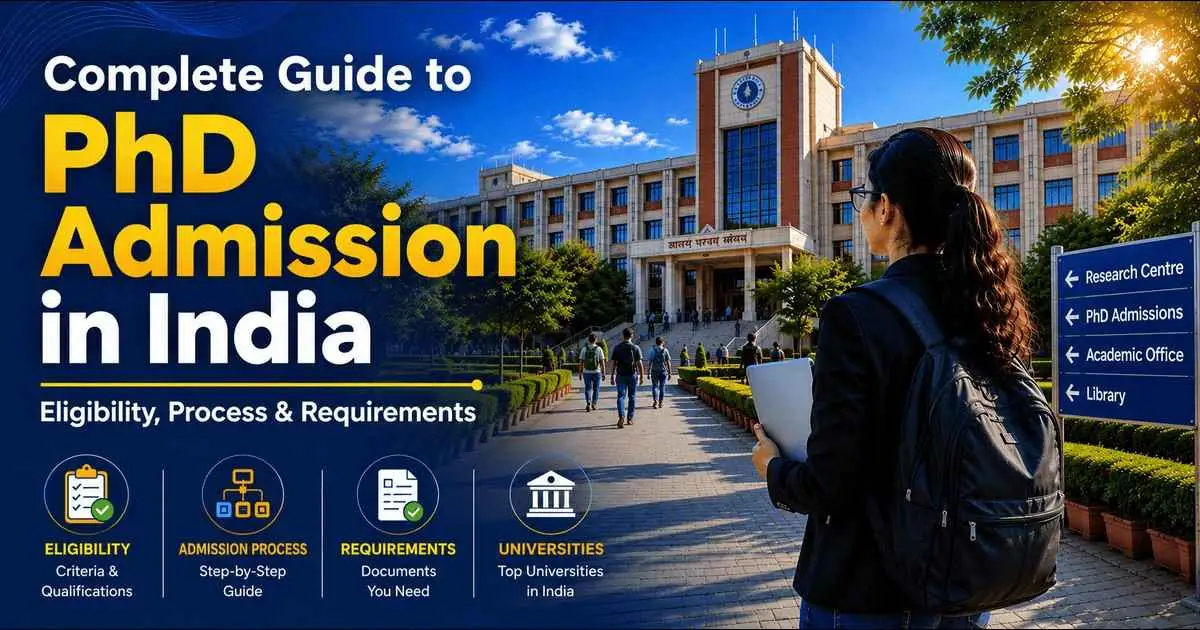
Struggling to Understand the PhD Admission Process in India?
Planning to pursue a PhD is an important step for anyone interested in research, innovation, or an academic career. Understanding the PhD Admission in India process is essential because every university follows its own admission guidelines, eligibility criteria, and selection procedures. Many students spend hours visiting university websites only to find different rules for each institution.
The good news is that the overall PhD admission process follows a similar pattern across most universities in India. Once you understand the eligibility criteria, admission process, entrance exams, and required documents, applying becomes much easier. This guide explains everything you need to know so you can prepare confidently and avoid common mistakes.
PhD Admission in India
If you're looking for a quick overview, here are the basic requirements for PhD admission in India.
The basic PhD Admission Requirements at most universities include:
-
A relevant master's degree from a recognized university
-
Minimum qualifying marks as per university regulations
-
Entrance examination (if applicable)
-
Research proposal (required by some universities)
-
Personal interview or viva voce
-
Successful document verification
Although admission procedures may differ between universities, understanding these common requirements will help you prepare effectively before applying.
PhD Eligibility Criteria in India
Before applying for PhD Admission in India, ensure that you meet the eligibility criteria specified by your preferred university.
Educational Qualification
Most Indian universities require applicants to have a relevant postgraduate degree from a recognized institution. Your academic background should match the research area you intend to pursue.
For example, a student with a Master's degree in Computer Science can choose research areas such as Artificial Intelligence, Data Science, Cybersecurity, or Software Engineering.
Minimum Academic Requirements
Universities generally specify a minimum percentage or CGPA in their admission notifications. Reserved category candidates may receive relaxation according to applicable government regulations.
Meeting the minimum eligibility does not guarantee admission. Universities also consider your research aptitude, academic performance, research proposal, and interview performance.
Who Can Apply?
PhD admission is suitable for:
- Recent postgraduate students
- Working professionals
- Assistant professors
- Research scholars
- Industry professionals interested in research
- Individuals seeking careers in academia, research institutions, or industrial R&D
Before applying, always refer to the latest admission notification issued by the university.
Step-by-Step PhD Admission Process in India
Understanding each stage of the PhD Admission in India process helps you prepare in an organized manner and improves your chances of success.
Step 1: Choose the Right Research Area
Choosing a research topic is one of the most important decisions in your PhD journey. Since doctoral research usually takes several years, select a topic that genuinely interests you instead of choosing one simply because it is currently popular.
Ask yourself:
- Which subject interests me the most?
- What problem do I want to solve?
- Is there sufficient research scope?
- Does the topic match my academic background?
Instead of selecting a broad field like Artificial Intelligence, choose a focused research area such as Explainable AI, AI in Healthcare, Machine Learning for Agriculture, Natural Language Processing, or Cybersecurity using Deep Learning.
A clearly defined research topic demonstrates better planning and helps you prepare a stronger research proposal.
Step 2: Select the Right University
Selecting the right university is just as important as selecting the right research topic.
Rather than choosing a university only because of its ranking, evaluate its research environment. Consider factors such as faculty expertise, research facilities, publication record, industry collaborations, research funding, and experienced supervisors.
A university with strong research support and experienced faculty can provide a better learning environment throughout your doctoral journey.
Step 3: Read the Admission Notification Carefully
Every university publishes an official admission notification containing important details about the admission process.
Before applying, carefully review information related to:
- Eligibility criteria
- Available research disciplines
- Application schedule
- Entrance examination details
- Interview process
- Required documents
- Application fee
- Important instructions
Reading the official admission notification carefully is one of the most important steps in PhD Admission in India, helping you avoid mistakes and submit a complete application before the deadline.
Step 4: Submit Your PhD Application
Most universities accept applications through online admission portals.
As part of the application process, you will usually need to:
- Complete the online application form
- Enter academic and personal details
- Select your research department
- Upload the required documents
- Pay the application fee
- Submit the application before the closing date
Before clicking the final submit button, review every detail carefully. Even minor errors in personal information or uploaded documents can delay your PhD Admission in India process.
Step 5: Prepare for the Entrance Examination
Many universities conduct entrance examinations to evaluate a candidate's research aptitude and subject knowledge.
The examination usually includes:
- Research methodology
- Logical reasoning
- Analytical ability
- Subject-specific knowledge
- Quantitative aptitude (where applicable)
Preparing consistently over several weeks is far more effective than last-minute preparation. If you have already qualified national-level examinations accepted by your chosen university, check whether you are eligible for any exemptions.
Step 6: Attend the PhD Interview or Viva Voce
Candidates who qualify for the entrance examination are generally invited for an interview or viva voce.
The interview panel usually evaluates your:
- Research interest
- Subject knowledge
- Critical thinking ability
- Research proposal
- Problem-solving skills
- Motivation for pursuing a PhD
Answer questions honestly and confidently. A clear understanding of your research topic often creates a better impression than memorized answers.
Step 7: Final Selection and Admission
The final selection is usually based on multiple factors, including academic performance, entrance examination scores, interview performance, research proposal quality, and research potential.
After selection, candidates complete document verification, pay the admission fee, and formally enroll in the PhD program, marking the final stage of PhD Admission in India before beginning coursework or research under the guidance of their supervisor.
PhD Admission Timeline in India
Although the PhD Admission in India schedule differs from one university to another, most universities follow a similar admission process. Understanding the typical timeline helps you plan your preparation, complete applications on time, and avoid missing important deadlines.
|
Admission Stage |
Typical Timeline |
|
Admission Notification |
Varies by University |
|
Online Application |
Usually 2–6 Weeks |
|
Entrance Examination |
As per University Schedule |
|
Interview / Viva Voce |
After Entrance Exam Results |
|
Merit List & Final Selection |
Within a Few Weeks |
|
Document Verification |
After Selection |
|
Fee Payment & Admission Confirmation |
Before Coursework Begins |
|
Coursework / Research Registration |
As Per University Calendar |
Tip: Check your preferred university's official website regularly for admission notifications, important dates, and application updates. Preparing early gives you enough time to organize documents and complete the application without unnecessary stress.
Documents Required for PhD Admission
Keeping your documents ready before the PhD Admission in India process begins can save time and prevent last-minute problems. Although document requirements vary across universities, most institutions generally ask applicants to submit the following.
Essential Documents Checklist
- Master's Degree Certificate
- Bachelor's Degree Certificate
- Consolidated Mark Sheets
- Valid Government Identity Proof
- Passport-Size Photographs
- Research Proposal (if required)
- Statement of Purpose (SOP), if required
- Entrance Examination Scorecard (UGC-NET, CSIR-NET, GATE, or equivalent), if applicable
- Experience Certificate (for working professionals, if applicable)
- Category Certificate (SC/ST/OBC/EWS/PwD), if applicable
Before You Apply, Keep These Documents Ready
Preparing everything in advance helps you complete your online application quickly and reduces the chances of technical errors.
Before you begin your application, keep the following ready:
- Scanned PDF copies of all required documents
- Passport-size photographs in the prescribed format
- Updated Resume or Curriculum Vitae (CV), if required
- Active Email ID
- Mobile Number for admission updates and OTP verification
- No Objection Certificate (NOC) from your employer, if applicable
- Documents renamed clearly for easy uploading
- Files saved in the required format and file size
- A separate folder containing all admission documents
Pro Tip: Before submitting your application, verify that every uploaded document is clear, complete, and matches the university's required format. Spending a few extra minutes on verification can help you avoid rejection or delays during document verification.
Common Mistakes to Avoid During PhD Admission
Even well-qualified candidates sometimes lose admission opportunities because of avoidable mistakes.
Avoid these common errors:
- Applying without checking eligibility criteria
- Choosing a research topic without proper planning
- Writing a weak or generic research proposal
- Ignoring university-specific admission guidelines
- Uploading incomplete or incorrect documents
- Waiting until the last date to apply
- Preparing only for the entrance examination while neglecting interview preparation
A well-planned approach and careful preparation can significantly improve your chances of success in PhD Admission in India.
Expert Tips for Successful PhD Admission
If you are planning to pursue a PhD in India, these practical tips can help you prepare more effectively.
- Start planning your admission several months in advance.
- Read recent research papers in your chosen area.
- Prepare a clear and focused research proposal.
- Improve your understanding of research methodology.
- Practice answering interview questions confidently.
- Organize all required documents before applications begin.
- Apply to multiple universities instead of depending on a single option.
- Follow official university admission notifications regularly.
- Seek expert academic guidance whenever required.
Consistent preparation and proper planning can make the admission process much smoother and increase your chances of success.
Ready to Begin Your PhD Journey?
Successfully securing PhD Admission in India requires more than meeting the minimum eligibility criteria. Choosing the right research area, selecting a suitable university, preparing a strong research proposal, and completing every stage of the admission process carefully can significantly improve your chances of success.
If you need guidance with PhD admission, research topic selection, research proposal writing, Statement of Purpose (SOP) preparation, literature review, or interview preparation, professional academic guidance can help you make informed decisions and prepare a strong application.
With the right planning, consistent preparation, and expert support, you can begin your PhD journey with confidence and build a successful career in research and academia.