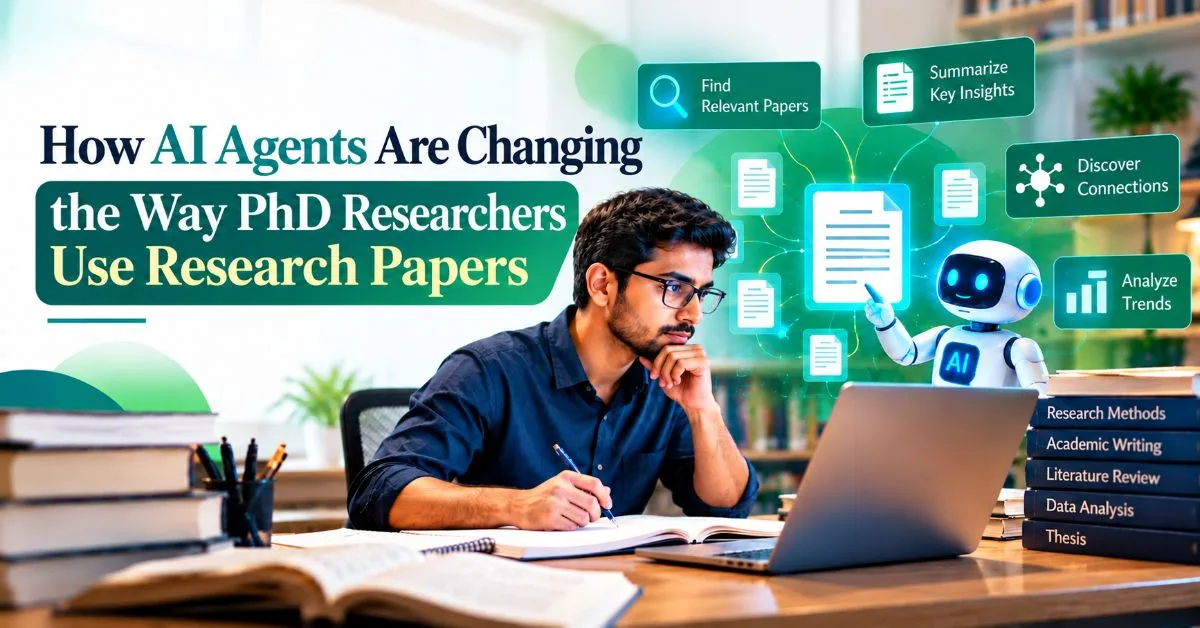

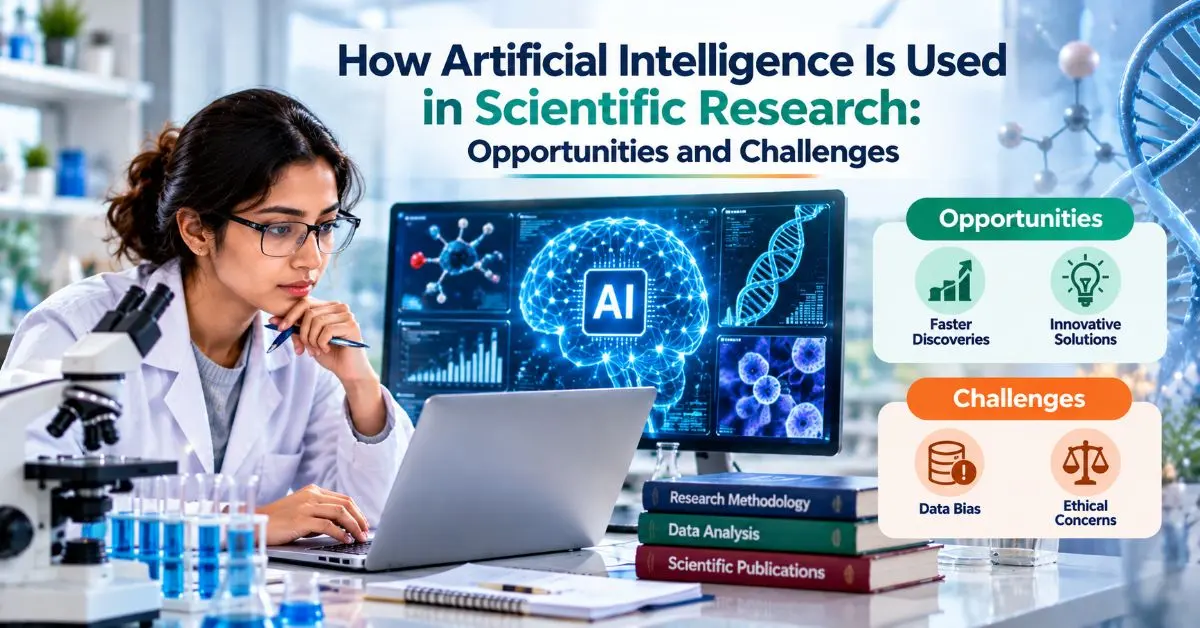
Artificial intelligence (AI) is changing how researchers collect, analyse, and interpret scientific data. It can help identify patterns, develop predictions, explore complex problems, and support scientific simulations. For PhD scholars and academic researchers, AI offers new ways to investigate research questions and improve analytical workflows.
However, AI-generated results are not always accurate. Researchers must consider data quality, scientific validation, research ethics, and reproducibility before drawing conclusions. This guide explains the main applications, benefits, challenges, and practical uses of AI in scientific research.
How Does AI Support Scientific Research?
Scientific research involves identifying a problem, reviewing existing studies, collecting data, analysing results, and developing evidence-based conclusions.
AI can support several stages of this process by analysing large datasets, recognising patterns, and predicting possible outcomes. For example, an environmental researcher can use machine learning to examine the relationship between traffic levels and air pollution.
AI can help researchers investigate scientific questions, but sound research still depends on credible evidence, suitable methods, and human judgment.
How Is AI Used in Scientific Research?
1. Scientific Prediction
AI models can analyse historical data to estimate possible future outcomes. Researchers use these methods in environmental science, healthcare, engineering, and energy research.
Common applications include:
- Weather and climate forecasting.
- Disease-risk prediction.
- Energy consumption forecasting.
- Air pollution estimation.
- Equipment failure prediction.
For example, engineers can use machine sensor data to spot potential equipment failures. The model's predictions must be tested to determine whether they remain reliable with new data.
2. Scientific Simulation
AI-assisted computational methods help researchers explore possible scenarios before conducting expensive or time-consuming experiments.
Applications include material property prediction, energy system modelling, climate simulations, and engineering analysis.
For example, a materials researcher may use computational models to identify promising materials for laboratory testing. The predicted results still require appropriate verification.
3. Drug and Materials Discovery
AI can help researchers examine large collections of chemical compounds, molecular structures, and material properties.
Computational models can identify candidates that deserve further investigation, reducing the number of possibilities researchers need to examine initially.
However, identifying a promising drug candidate does not establish its safety or effectiveness. Appropriate laboratory testing and further evaluation remain necessary.
4. Data Analysis and Pattern Recognition
Scientific datasets may contain thousands or millions of observations. AI can help researchers classify information, analyse images, identify unusual observations, and investigate relationships between variables.
For example, researchers studying plant health can use AI to classify leaf images and identify visible symptoms. The results should be checked against reliable observations and expert assessments.
5. Research Literature Exploration
AI tools can assist with organising literature searches, summarising documents, and identifying connections between research topics.
These capabilities can help researchers explore possible research questions and identify areas for further investigation.
However, researchers should verify references, publication details, and scientific claims against original sources. AI-generated summaries should not replace critical reading of research papers.
Can AI Help Discover New Scientific Relationships?
Yes. AI can identify patterns that may be difficult to notice when examining complex datasets manually.
For example, an AI model might identify an association between traffic density and air pollution levels. However, this association does not automatically prove that traffic caused the observed pollution levels. Weather conditions, industrial activity, and other factors may also influence the results.
Researchers should examine data quality, consider alternative explanations, validate findings, and compare results with existing studies.
The goal is to establish scientifically meaningful findings rather than simply generate predictions.
What Opportunities Does AI Create for PhD Researchers?
AI offers several opportunities for doctoral researchers across different disciplines.
- Faster data analysis: AI can help process large datasets and automate repetitive analytical tasks.
- New research directions: Researchers can investigate machine learning, robotics, healthcare, environmental modelling, and scientific computing.
- Predictive modelling: AI can help estimate outcomes and compare predictions with actual observations.
- Interdisciplinary research: Researchers can combine computational techniques with knowledge from engineering, biology, statistics, and other fields.
- Experimental planning: Computational models may help identify promising scenarios for further investigation.
These benefits depend on selecting suitable methods and evaluating the results carefully.
What Are the Limitations of AI in Scientific Research?
Despite its advantages, AI presents several challenges that researchers should understand.
1. Data Quality and Bias
Incomplete, inaccurate, or biased data can produce misleading results. Researchers should check data sources, identify missing values, and assess whether the dataset represents the research problem adequately.
2. Scientific Validation
AI predictions should not automatically be treated as established findings. Researchers need appropriate validation methods, performance metrics, and independent evidence where necessary.
3. Reproducibility
Researchers should clearly explain their analysis methods so others can understand how the results were obtained. Documenting data sources, pre-processing methods, model settings, evaluation metrics, and software versions helps improve transparency and reproducibility.
4. Computational Requirements
Some AI models require powerful hardware, specialist software, and large datasets. Researchers should consider their available resources before selecting a method. Sometimes, a simpler statistical method may be a better choice.
5. Research Ethics and Academic Integrity
AI use can raise concerns about privacy, confidential data, fabricated references, plagiarism, and authorship responsibilities. Researchers should follow institutional policies and journal guidelines, disclose AI assistance when required, and remain responsible for their submitted work.
How to Use AI in Scientific Research: A Simple Workflow

Researchers can follow these six steps when planning an AI-assisted study.
- Define the research problem: Establish the research question, objectives, and expected contribution.
- Collect and examine data: Check data quality, completeness, relevance, and permissions.
- Select a suitable method: Decide whether AI, statistical analysis, simulation, or a combination of methods is appropriate.
- Develop and test the model: Evaluate performance using suitable validation procedures.
- Interpret the findings: Review the results against existing evidence and identify any limitations.
- Document the research: Record the methodology, results, and relevant decisions so others can assess the work.
This is a general workflow. The exact steps depend on the research discipline and study design.
Practical Example: AI for Environmental Research
Consider a PhD scholar studying air pollution in an urban area.
The researcher collects temperature, humidity, traffic information, geographic data, and historical pollution measurements.
The researcher then prepares the dataset, selects an appropriate prediction method, and develops an AI model to estimate pollution levels. The predictions are compared with actual measurements to evaluate performance.
The researcher must also check whether the dataset represents different locations and seasons and whether the model performs reliably on previously unseen data.
The research contribution could be an improved prediction method or a better understanding of factors associated with pollution levels. The conclusions must be supported by the study's results.
What Skills Should PhD Researchers Develop?
Researchers do not necessarily need to become AI specialists. However, the following skills can help them use AI more effectively:
- Research methodology and study design.
- Statistics and data analysis.
- Machine learning fundamentals.
- Programming and scientific computing, where relevant.
- Data visualisation and model evaluation.
- Critical thinking and research ethics.
- Documentation and reproducible research practices.
Understanding when AI is appropriate and how to verify its results is more important than simply knowing how to use an AI tool.
How AI May Shape the Future of Scientific Research
AI is likely to remain an important part of scientific research as computational methods and research tools continue to develop. Researchers may increasingly use AI for data analysis, prediction, simulation, and experimental planning.
However, reliable scientific conclusions will continue to depend on accurate data, suitable research methods, transparent reporting, and careful validation.
The most effective approach combines AI capabilities with scientific knowledge and human judgement.
Conclusion
Artificial intelligence offers researchers new ways to analyse data, explore scientific problems, and develop predictions. For PhD scholars, it can support research planning and open up opportunities across different disciplines.
However, successful AI-assisted research requires reliable data, suitable methods, scientific validation, and responsible practices. AI is most useful when researchers use it to support their work while applying critical thinking and taking responsibility for their findings.

References and Further Reading
1. Gao, J. and Wang, D. (2024). Quantifying the use and potential benefits of artificial intelligence in scientific research. Nature Human Behaviour. https://www.nature.com/articles/s41562-024-02020-5
2. OECD (2023). Artificial Intelligence in Science: Challenges, Opportunities and the Future of Research. https://doi.org/10.1787/a8d820bd-en