
Writing a dissertation is one of the most demanding stages of a PhD journey. Many research scholars struggle with choosing a research topic, conducting a literature review, selecting the right methodology, analyzing data, and meeting submission deadlines. Without a clear plan, these challenges can delay progress and affect the quality of the research.
The good news is that dissertation writing becomes much easier when you follow a structured, step-by-step approach. This guide explains every stage of dissertation writing in simple, practical language. Whether you are beginning your research or preparing your final draft, this article will help you complete a well-organized, high-quality dissertation with confidence.
Step-by-Step Dissertation Writing Guide

Writing a dissertation becomes much easier when you divide the process into manageable stages. Following these steps helps you stay organized, maintain research quality, and complete your dissertation on time.
1. Choose a Research Topic
Choosing the right research topic is the first and most important step in dissertation writing. Your topic should be relevant to your field, address a genuine research gap, and be achievable within your available time and resources. A focused topic helps you conduct meaningful research and maintain clarity throughout your dissertation.
Example:
- Broad Topic: Artificial Intelligence in Healthcare
- Focused Topic: Predicting Early Heart Disease Using Machine Learning Algorithms
Before finalizing your topic, consider:
- Is the research problem significant?
- Is sufficient literature available?
- Can reliable data be collected?
- Is the topic feasible within your research timeline?
2. Conduct a Comprehensive Literature Review
A literature review helps you understand existing research, identify knowledge gaps, and establish a strong foundation for your dissertation. Instead of simply summarizing previous studies, critically evaluate them to determine how your research will contribute to the field.
Example: If your research focuses on blockchain security, you may discover that most studies emphasize financial applications, while limited research explores blockchain for healthcare data security. This research gap can become the focus of your dissertation.
A strong literature review should:
- Identify key theories and concepts.
- Compare previous research findings.
- Highlight unresolved research gaps.
- Justify the need for your study.
3. Develop Clear Research Questions and Objectives
Research questions define the direction of your dissertation and keep your study focused. They should be specific, measurable, researchable, relevant, and aligned with your research objectives.
Example
Research Topic: Machine Learning-Based Crop Yield Prediction
Research Questions:
- Which machine learning algorithm provides the highest prediction accuracy?
- What environmental factors influence crop yield the most?
- How can predictive models support sustainable agriculture?
Clearly defined research questions improve the quality and relevance of your research.
4. Select an Appropriate Research Methodology
Your research methodology explains how you will conduct your study and collect data. The right approach depends on your research objectives and the type of data you need.
- Quantitative Research: Uses numerical data, surveys, experiments, and statistical analysis.
- Qualitative Research: Explores opinions, experiences, and behaviors through interviews, case studies, or observations.
- Mixed Methods Research: Combines quantitative and qualitative approaches for comprehensive research.
Your methodology should clearly explain the research design, sampling method, data collection techniques, research instruments, and data analysis methods.
5. Collect Reliable Data
Collecting accurate data is essential for producing trustworthy research findings. Depending on your methodology, you may use surveys, interviews, experiments, public datasets, government reports, or industry databases.
Always obtain informed consent, maintain confidentiality, and follow ethical research practices.
Example: Customer satisfaction research may use online surveys, while leadership studies often rely on interviews with experienced managers.
6. Analyze the Collected Data
Data analysis converts raw information into meaningful findings that answer your research questions.
- Quantitative Analysis: Descriptive statistics, correlation, regression, ANOVA, and hypothesis testing.
- Qualitative Analysis: Thematic analysis, content analysis, coding, and narrative analysis.
Example: A study may reveal that educational use of social media improves academic performance, while excessive entertainment use negatively affects learning outcomes.
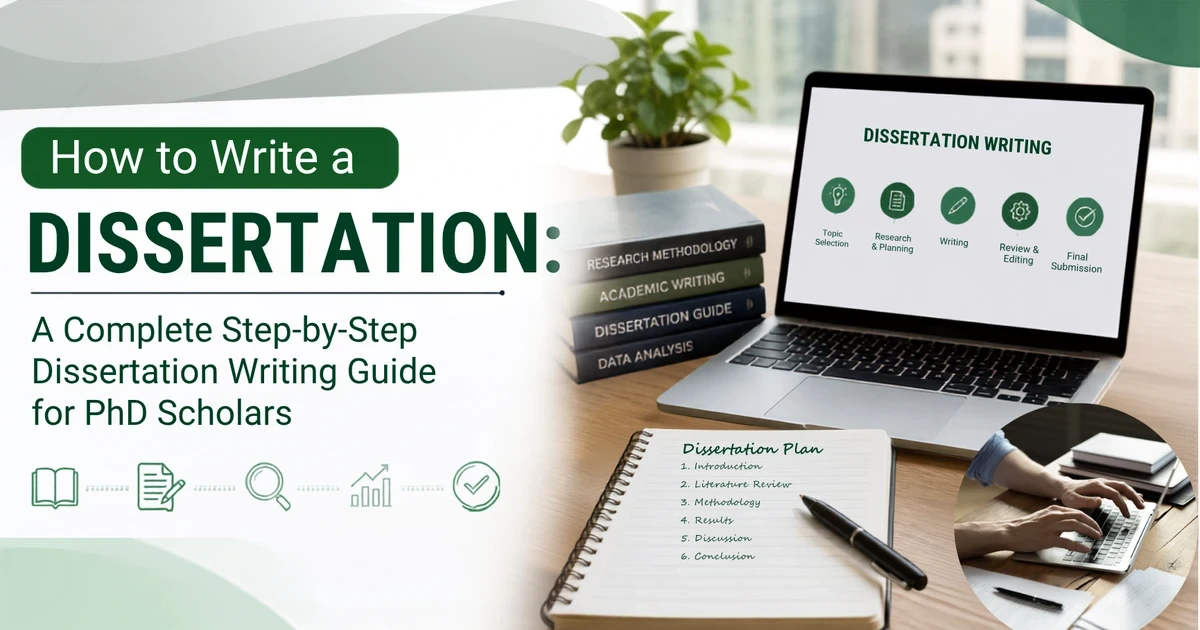
7. Write Each Dissertation Chapter
Once your research is complete, begin writing one chapter at a time to maintain clarity and consistency.
- Introduction: Present the research problem, objectives, and significance.
- Literature Review: Summarize existing studies and identify research gaps.
- Research Methodology: Explain your research design and data collection methods.
- Results: Present findings using tables, charts, and statistical evidence.
- Discussion: Interpret the findings and compare them with previous studies.
- Conclusion: Summarize key findings, limitations, contributions, and future research recommendations.
Maintaining a logical structure and consistent academic writing style will improve the overall quality of your dissertation.
Best Dissertation Writing Tips for PhD Scholars
Writing a dissertation is a long-term academic commitment that requires planning, consistency, and discipline. Instead of trying to complete everything at once, focus on making steady progress every week. The following tips can help you improve the quality of your dissertation and reduce unnecessary stress.
- Start Early: Begin your research and writing as early as possible to allow sufficient time for revisions.
- Create a Writing Schedule: Set realistic weekly goals and maintain a consistent writing routine.
- Stay Organized: Keep research papers, datasets, references, and notes properly organized for easy access.
- Seek Regular Feedback: Discuss your progress with your supervisor and incorporate constructive suggestions.
- Revise Thoroughly: Review multiple drafts to improve clarity, strengthen arguments, and correct grammar or formatting errors.
Consistent effort and proper planning will help you produce a well-structured, high-quality dissertation.
Common Dissertation Writing Mistakes to Avoid
Many PhD scholars make avoidable mistakes that affect the quality of their dissertations. Choosing a broad research topic, conducting a descriptive instead of critical literature review, selecting an inappropriate methodology, and failing to answer research questions clearly are common issues. Other mistakes include poor citation practices, inconsistent formatting, weak data interpretation, ignoring supervisor feedback, and skipping proofreading or plagiarism checks. Identifying and avoiding these mistakes improves the originality, credibility, and academic quality of your dissertation.
Dissertation Writing Tools Every PhD Scholar Should Use
The right tools can simplify research, improve writing quality, and make dissertation writing more efficient.
|
Tool |
Purpose |
|
Google Scholar |
Find scholarly articles and research papers |
|
Zotero / Mendeley |
Manage references and generate citations |
|
Grammarly |
Improve grammar, spelling, and writing clarity |
|
Microsoft Word |
Write, edit, and format your dissertation |
|
Turnitin |
Check plagiarism and similarity scores |
|
SPSS / R |
Analyze quantitative research data |
|
NVivo |
Analyze qualitative data and interview transcripts |
Dissertation Writing Timeline (Month-by-Month Plan)
A structured timeline helps you complete your dissertation on schedule while leaving enough time for revisions and supervisor feedback.
|
Timeline |
Key Activities |
|
Months 1–2 |
Select a research topic, identify research gaps, and prepare the research proposal. |
|
Months 3–4 |
Conduct a literature review and finalize research questions and objectives. |
|
Months 5–6 |
Design the research methodology, obtain ethical approval if required, and prepare research instruments. |
|
Months 7–9 |
Collect, organize, and validate research data. |
|
Months 10–11 |
Analyze data, interpret findings, and prepare tables and figures. |
|
Month 12 |
Complete writing, edit, proofread, check plagiarism, and prepare for final submission. |
Following this timeline helps reduce last-minute pressure and keeps your research on track.
Dissertation Formatting Guidelines (APA, MLA, IEEE, Chicago, Harvard)
Most universities require dissertations to follow a specific citation and formatting style. Always confirm your institution's requirements before preparing the final document.
- APA Style: Commonly used in education, business, and social sciences. It follows an author-date citation system.
- MLA Style: Widely used in humanities and literature. It uses author-page citations and a Works Cited page.
- IEEE Style: Preferred in engineering and computer science. References are numbered in the order they appear.
- Chicago Style: Frequently used in history and arts, supporting both notes-bibliography and author-date formats.
- Harvard Style: Popular across many disciplines and uses an author-date referencing system.
Using the correct formatting style consistently improves the professionalism and academic credibility of your dissertation.
Dissertation Submission Checklist
Before submitting your dissertation, complete a final review to ensure it meets your university's academic and formatting requirements. A simple checklist can help you avoid common mistakes and submit your work with confidence.
- Research topic and objectives are finalized.
- All dissertation chapters are complete.
- Research questions have been fully addressed.
- Literature review supports your research gap.
- Citations and references follow the required style.
- Tables, figures, and formatting are accurate.
- Grammar, spelling, and punctuation have been checked.
- Plagiarism is within the university's acceptable limit.
- Supervisor feedback has been incorporated.
- The final document is saved in the required submission format.
Completing this checklist ensures your dissertation is accurate, well-organized, and ready for successful submission.
Need Help with Your Dissertation?
Dissertation writing can be challenging, especially when balancing research, academic writing, data analysis, and submission deadlines. If you're facing difficulties at any stage, expert guidance can make the process easier and more efficient.
Our dissertation guidance services include:
- Research topic selection
- Research proposal writing
- Literature review assistance
- Research methodology guidance
- Data analysis (SPSS, MATLAB, Python, and R)
- Editing and proofreading
- Plagiarism checking
- Viva preparation
Whether you're starting your research or completing the final draft, personalized guidance can help you produce a high-quality dissertation with confidence.
Why Choose Expert Dissertation Guidance?
Expert guidance provides structured support throughout your PhD journey. Experienced mentors help you choose a suitable research topic, design an effective methodology, analyze data accurately, and improve your academic writing. They also review your dissertation, provide constructive feedback, and ensure your work meets university standards. With professional assistance, you can avoid common mistakes, manage your time effectively, and prepare confidently for your dissertation submission and viva examination.
Final Thoughts
Writing a dissertation is one of the most important milestones in a PhD scholar's academic journey. By following a structured approach, staying organized, and seeking regular feedback, you can complete a well-researched and professionally written dissertation. Careful planning, consistent effort, and attention to academic integrity are the keys to success.
Ready to Begin Your Dissertation with Confidence?
If you need expert support with dissertation writing, research methodology, data analysis, formatting, plagiarism checking, or viva preparation, our experienced academic mentors are here to help. Get personalized dissertation guidance tailored to your research needs and take the next step toward successfully completing your PhD.