

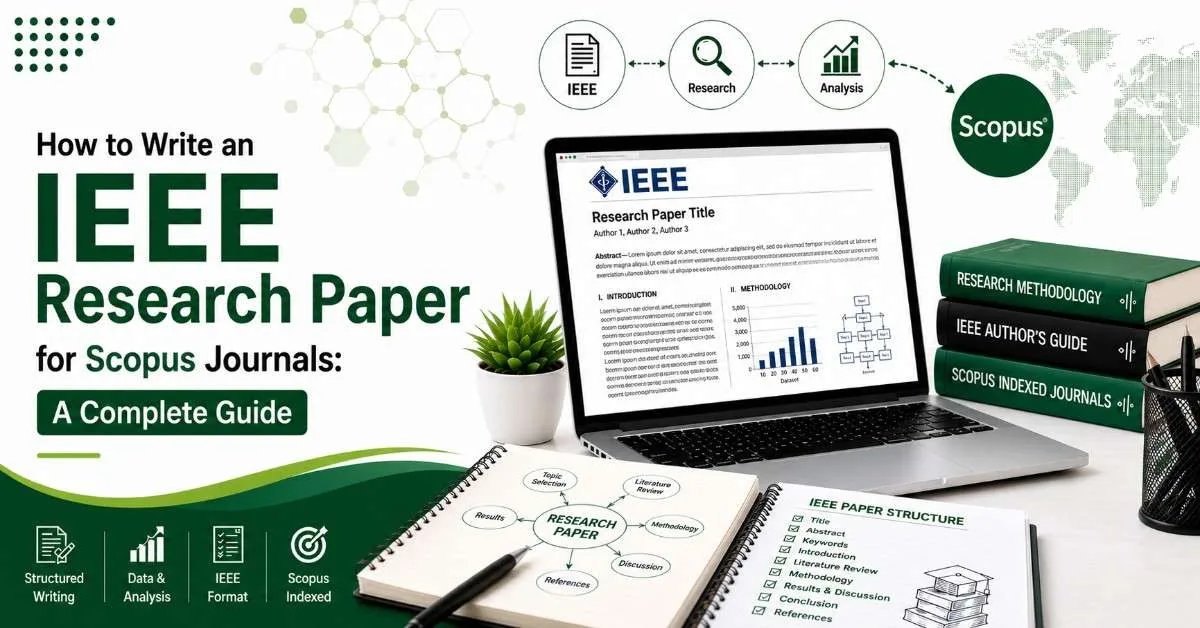
Writing a research paper is one of the most important milestones for researchers, PhD scholars, postgraduate students, and academicians. A well-written IEEE research paper not only presents your research findings effectively but also improves your chances of publication in reputed IEEE and Scopus-indexed journals.
However, many researchers struggle with selecting a research topic, organizing their ideas, following the correct paper structure, and meeting journal formatting requirements. Even strong research can be rejected if it is poorly written or submitted to the wrong journal.
This comprehensive guide explains everything you need to know from planning your research to formatting your manuscript and selecting the right journal for publication.
What Is an IEEE Research Paper?
An IEEE research paper is a technical research article written according to the publishing standards established by the Institute of Electrical and Electronics Engineers (IEEE). These papers commonly cover engineering, computer science, electronics, artificial intelligence, data science, communication systems, robotics, and related disciplines.
A standard IEEE paper presents:
- Original research findings
- Problem statement
- Research methodology
- Experimental validation
- Results and analysis
- References following IEEE citation style
IEEE publications are recognized worldwide for their high academic standards and rigorous peer-review process.
What Are Scopus Journals?
Scopus is one of the world's largest abstract and citation databases maintained by Elsevier. Instead of publishing journals, Scopus indexes high-quality journals across engineering, science, medicine, social sciences, business, and many other academic disciplines.
Publishing in Scopus-indexed journals helps researchers:
- Increase research visibility
- Improve citation opportunities
- Build academic credibility
- Meet university and funding requirements
- Strengthen career and promotion prospects
Many IEEE journals are also indexed in Scopus, making them highly valuable publication options.
IEEE vs Scopus Journals
Although these terms are often used together, they are not the same.
|
IEEE |
Scopus |
|
IEEE is a professional organization and publisher. |
Scopus is a journal indexing database. |
|
Publishes IEEE conferences and journals. |
Indexes journals from multiple publishers. |
|
Uses IEEE publication standards. |
Includes journals from IEEE, Elsevier, Springer, Wiley, MDPI, Taylor & Francis, and others. |
|
Focuses mainly on engineering and technology. |
Covers multiple academic disciplines. |
Before You Start Writing
Good research papers begin long before the writing process. Proper planning improves both quality and publication success.
Choose a Relevant Research Topic
Select a topic that:
- Solves a real-world problem
- Matches your research interests
- Has sufficient literature available
- Contributes something new
Avoid choosing topics that are already extensively researched unless you can provide a meaningful improvement.
Identify the Research Gap
A research gap is the limitation or unanswered question in existing studies.
Ask yourself:
- What problem still exists?
- What previous studies failed to solve?
- How will my research improve current knowledge?
A clearly defined research gap forms the foundation of a strong publication.
Perform a Literature Review
Study recent papers published in IEEE and Scopus journals to understand:
- Current research trends
- Existing methodologies
- Research limitations
- Frequently cited papers
A thorough literature review helps avoid duplication and supports your research contribution.
Define Clear Research Objectives
Your objectives should clearly explain:
- What problem you are solving
- Why it matters
- How you plan to solve it
- What outcomes you expect
Well-defined objectives guide the entire research process.
Once you have selected your research topic, identified the research gap, completed the literature review, and defined your objectives, you are ready to begin writing your IEEE research paper by following the standard structure used for publication in Scopus-indexed journals.
How to Write an IEEE Research Paper (Step-by-Step)
1. Write a Clear and Specific Title
Your title should accurately describe your research while remaining concise and informative.
A strong title:
- Includes important keywords
- Reflects the main contribution
- Avoids unnecessary words
- Attracts readers without being misleading
2. Prepare an Effective Abstract
The abstract summarizes your complete study in a single section.
It should briefly cover:
- Research problem
- Objectives
- Methodology
- Major findings
- Conclusion
Since many readers only read the abstract before deciding to continue, it should be clear, informative, and engaging.
3. Select Appropriate Keywords
Keywords help improve the visibility of your research in academic databases and search engines.
Choose 5–8 keywords that accurately describe your research area, methodology, and application.
4. Write the Introduction
The introduction should answer four key questions:
- What is the problem?
- Why is it important?
- What have previous researchers done?
- What does your work contribute?
End the introduction by clearly stating your research objectives and paper organization.
5. Review Existing Literature
Summarize relevant studies while identifying their strengths and limitations.
Instead of simply listing previous work, compare approaches and explain how your research differs or improves upon them.
6. Explain Your Methodology
Describe your research process in sufficient detail so that others can reproduce your work.
Include:
- Research design
- Algorithms or models
- Data collection methods
- Software or tools used
- Experimental setup
- Evaluation metrics
A transparent methodology builds confidence in your findings.
7. Present the Results
Use well-labeled tables, figures, and graphs to present your findings clearly.
Focus on:
- Key observations
- Performance comparisons
- Statistical evidence where applicable
- Visual clarity
Avoid repeating every value already shown in tables.
8. Discuss Your Findings
Interpret the results rather than simply describing them.
Explain:
- Why the results occurred
- How they compare with previous studies
- Practical implications
- Limitations of your work
- Opportunities for future research
A thoughtful discussion demonstrates the significance of your contribution.
9. Write a Strong Conclusion
Summarize:
- Research objective
- Major findings
- Key contribution
- Practical significance
- Future research directions
Avoid introducing new information in the conclusion.
10. Prepare References
Use only credible and relevant references from reputable journals, conference papers, books, and official publications.
Ensure all citations follow the required IEEE referencing style and are consistent throughout the manuscript.
IEEE Research Paper Structure
An IEEE research paper is typically structured as follows:
- Title
- Author Details
- Abstract
- Keywords
- Introduction
- Literature Review
- Methodology
- Results
- Discussion
- Conclusion
- Acknowledgment (if applicable)
- References
Maintaining this structure improves readability and aligns with IEEE publishing standards.
Formatting Guidelines
Before submission, verify that your manuscript follows the journal's author instructions.
Pay attention to:
- Official IEEE template
- Font style and size
- Margin settings
- Two-column layout (where required)
- Figure and table numbering
- Equation formatting
- Citation style
- Reference formatting
- Page limits
- Plagiarism requirements
Even high-quality research may face delays or rejection if formatting guidelines are ignored.
Choosing the Right Journal
Selecting the appropriate journal significantly increases your publication success.
Consider:
- Scope matches your research
- IEEE or Scopus indexing
- Peer-review process
- Acceptance rate
- Publication timeline
- Impact metrics (where relevant)
- Ethical publishing practices
- Author guidelines
Avoid submitting to journals that do not align with your research domain.
Common Reasons for Rejection
Many manuscripts are rejected due to avoidable issues such as:
- Weak research contribution
- Unclear problem statement
- Insufficient literature review
- Poor methodology
- Inadequate experimental validation
- Weak discussion
- Language and grammar errors
- Incorrect formatting
- High plagiarism
- Submitting to an unsuitable journal
Addressing these issues before submission can greatly improve your chances of acceptance.
Expert Writing Tips
To prepare a high-quality manuscript:
- Focus on originality and practical contribution.
- Use simple, precise, and formal academic language.
- Support claims with credible references.
- Keep figures and tables clear and readable.
- Proofread multiple times before submission.
- Follow the target journal's guidelines carefully.
- Ask your supervisor or peers to review your manuscript before submitting it.
Small improvements in clarity and presentation can make a significant difference during peer review.
Submission Checklist
Before submitting your manuscript, confirm that you have:
- Selected a suitable journal.
- Followed the required template.
- Written a clear title and abstract.
- Included relevant keywords.
- Organized the paper correctly.
- Verified all citations and references.
- Checked grammar and language.
- Ensured originality and acceptable plagiarism levels.
- Reviewed figures, tables, and equations.
- Completed all author information and required declarations.
A final review helps minimize common submission errors.
Conclusion
Publishing an IEEE research paper in an IEEE or Scopus-indexed journal requires more than good research it demands careful planning, a logical structure, accurate formatting, and compliance with publication guidelines. By selecting a meaningful research problem, conducting a thorough literature review, presenting a sound methodology, and following the correct manuscript structure, researchers can significantly improve their chances of successful publication.
Whether you are preparing your first manuscript or refining an existing study, following the steps outlined in this guide will help you write a professional, publication-ready research paper with greater confidence.
By following the steps explained in this guide, researchers can prepare a well-structured IEEE research paper that meets publication standards and improves the chances of successful submission to suitable Scopus-indexed journals.