
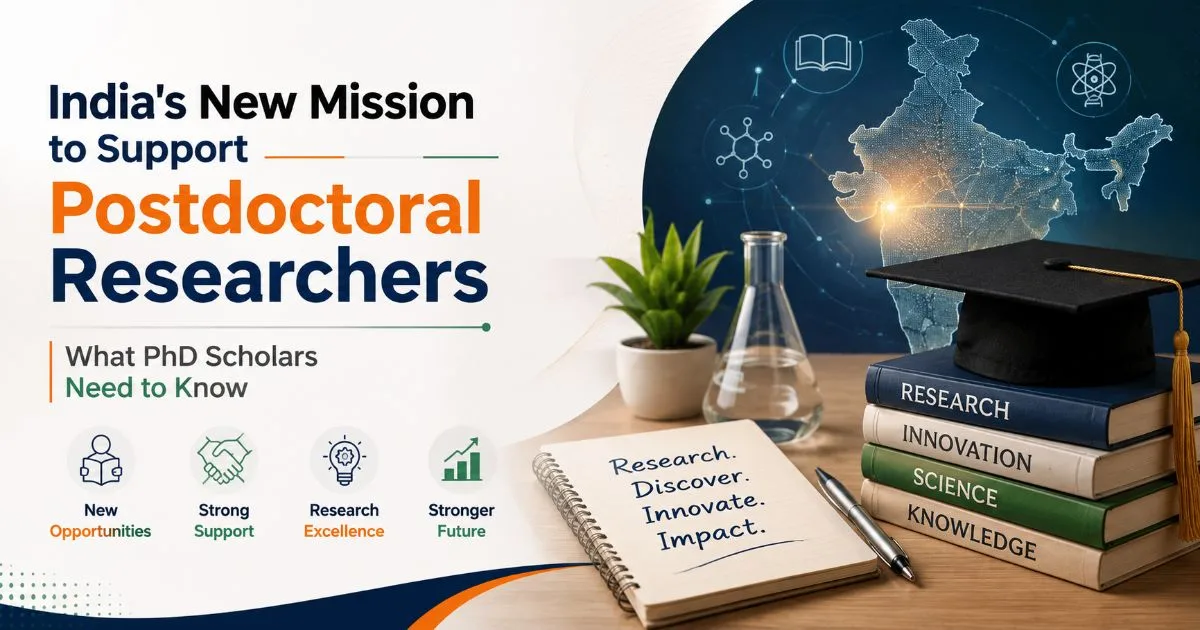
India is placing greater attention on what happens after researchers complete a PhD. A reported government roadmap, Mission Re-search, aims to strengthen opportunities for postdoctoral researchers by improving financial and academic support, increasing research positions, and making postdoctoral opportunities more competitive.
For PhD scholars, this development is important because completing a doctorate does not have to mean leaving research. A stronger postdoctoral ecosystem could give researchers more opportunities to pursue specialised research, collaborate with established research groups, and gain valuable experience for academic or R&D careers.
What Is Mission Re-search?
Mission Re-search has been reported as a roadmap intended to make India more attractive to postdoctoral researchers. The reported approach includes stronger financial and academic incentives, more research positions, and competitive stipends. Its broader objective is to retain research talent in India and strengthen the country's research and development ecosystem.
PhD scholars should, however, understand that this is a developing policy direction, not a guarantee of a postdoctoral position or a specific level of financial support. Actual opportunities will depend on the final framework, funding, institution, research area, and eligibility requirements.
Why Postdoctoral Research Matters for PhD Scholars
A PhD develops the ability to conduct independent research. A postdoctoral position can help researchers take that capability further through specialised projects, advanced methods, research collaborations, and new research directions.
For researchers planning an academic or research-focused career, a postdoc can help build:
- Deeper subject expertise
- Stronger research output
- Advanced research skills
- Research collaborations
- Project experience
- Academic networks
- Greater research independence
Therefore, a postdoc should not be viewed simply as another position after a PhD. It can be a bridge between doctoral training and a more independent research career.

What Could Change for Postdoctoral Researchers in India?
If the proposed direction is implemented effectively, one important change could be more accessible and attractive postdoctoral research opportunities in India. The reported roadmap focuses on increasing research positions and improving financial and academic incentives.
This could be particularly relevant to researchers who previously considered leaving India because of limited postdoctoral opportunities, funding, or research positions.
However, PhD scholars should evaluate an opportunity based on its overall research value rather than focusing only on the stipend. Research funding, infrastructure, mentorship, research freedom, collaboration, and career development can all influence the value of a postdoctoral position.
What Should PhD Scholars Look for in Postdoctoral Opportunities?
Before accepting an opportunity, postdoctoral researchers should evaluate:
Research funding: Is the project adequately supported?
Infrastructure: Are the required facilities, equipment, software, and datasets available?
Mentorship: Will an experienced researcher provide meaningful guidance?
Research freedom: Is there enough scope to develop independent ideas?
Collaboration: Can you work with researchers or institutions relevant to your field?
Career development: Will the experience strengthen your next career move?
India already has established postdoctoral support mechanisms. For example, the INSPIRE Faculty Fellowship provides eligible researchers with fellowship and research-grant components. PhD scholars should therefore consider the wider postdoctoral ecosystem rather than waiting for one new initiative.
Where Can Postdoctoral Researchers Find Opportunities?
Postdoctoral opportunities can exist across universities, research institutions, government-supported programmes, and specialised research organisations. Depending on the discipline, opportunities may be available in science and technology, engineering, healthcare, biotechnology, computer science and AI, social sciences, management, environmental research, and interdisciplinary research.
NITI Aayog has also recommended increasing postdoctoral fellowships and proposed a unified “Vigyan Nidhi” fellowship-support architecture to improve funding and administration.
How Should PhD Scholars Prepare?
The best time to prepare for a postdoc is before completing the PhD. Start by identifying the research direction you want to pursue.
Consider:
- What area do I want to continue researching?
- Which part of my PhD could become a future research programme?
- What new problem could I investigate?
- Which research groups work in this area?
- Which methods or technologies should I learn?
- Which institutions have the facilities I need?
A clear research direction can help you identify opportunities that genuinely fit your long-term goals.
Your PhD research, publications, and future interests should also form a logical research story:
PhD Research → Research Gap → New Research Question → Postdoctoral Proposal → Future Research Direction
Your postdoc does not have to be identical to your PhD. You can move into a related field, combine disciplines, or develop a new application of your expertise. The important point is being able to explain why the next research step makes sense.
How to Choose the Right Research Group
The institution's name should not be the only factor when selecting a postdoctoral position. Research the potential group before applying.
Check:
- Recent publications
- Current research projects
- Researcher's expertise
- Available infrastructure
- Existing collaborations
- Funding support
- Previous postdoctoral researchers
- Opportunities for independent research
A strong research environment should help you become a better researcher rather than simply add another position to your CV.
India or Overseas: What Should You Compare?
An overseas postdoc may still offer advantages such as specialised facilities, international collaboration, and strong research environments. If India's postdoctoral ecosystem becomes more competitive, researchers may have another option worth considering.
Rather than choosing only by location, compare:
- Research fit
- Mentor quality
- Funding
- Facilities
- Collaboration opportunities
- Publication potential
- Long-term career value
This approach helps postdoctoral researchers make a decision based on research and career goals rather than only stipend or institutional reputation.
What PhD Scholars Can Do Now
PhD scholars do not need to wait for the final shape of Mission Re-search. They can start preparing by:
Building a focused research profile: Make your research interests clear through your thesis, publications, and projects.
Strengthening research methodology: Develop the methods and analytical skills required in your field.
Tracking postdoctoral programmes: Follow official fellowship announcements and institutional research opportunities.
Building research connections: Connect with researchers whose work genuinely matches your interests.
Preparing a research proposal: Develop an idea that logically extends your doctoral expertise.
Comparing opportunities carefully: Do not choose only on the basis of stipend or institutional name.
Final Takeaway
India's growing focus on postdoctoral researchers could make the post-PhD research stage more attractive and strategically important. Mission Re-search is being developed as a roadmap, while existing programmes already provide routes for researchers to continue their work.
For PhD scholars, the practical response is preparation: build a strong research profile, identify a clear research direction, develop relevant skills, understand available fellowships, and evaluate research environments carefully.
A postdoc should not simply be the next position after a PhD. It should be a deliberate step toward the kind of researcher and career you want to build.
Ready to Plan Your Post-PhD Research Journey?
Get expert guidance on your research direction, postdoctoral opportunities, and research proposal preparation. Get Expert Research Guidance