

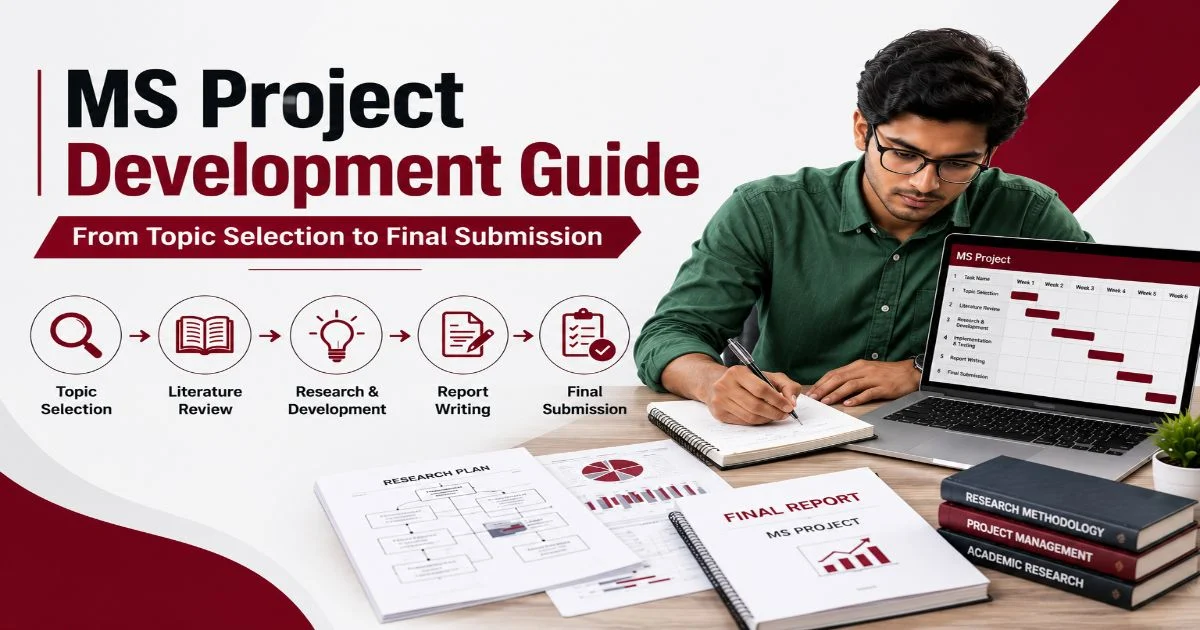
Many MS scholars begin their academic project journey with enthusiasm but soon face challenges when selecting a research topic, defining objectives, conducting literature reviews, implementing methodologies, and preparing final documentation. While selecting a project topic may seem easy, developing a successful MS project requires careful planning, technical expertise, research skills, and proper academic guidance to achieve the best results.
A poorly chosen topic can lead to delays, lack of innovation, difficulty in implementation, and even project rejection. Similarly, weak documentation, inadequate experimentation, and improper research methodologies can negatively impact academic performance.
Implementing a structured approach can significantly simplify the MS project development process and improve the likelihood of successful project completion. From choosing the right project topic to preparing the final submission, each phase of MS project development can be successfully accomplished through a well-planned approach, systematic execution, and expert guidance.
This guide explains the complete MS Project Development journey, from topic selection to final submission, and provides practical insights that help scholars successfully complete their projects while enhancing their research and technical skills
Understanding Research Projects and Their Importance
MS Project Development is a systematic process that involves identifying a research problem, designing a solution, implementing the project, evaluating outcomes, and documenting findings according to academic standards.
An MS project serves multiple purposes:
- Demonstrates technical and research competency
- Enhances problem-solving skills
- Contributes to academic knowledge
- Supports future research publications
- Improves career opportunities in industry and academia
Whether a scholar belongs to Computer Science, Electrical Engineering, Electronics Engineering, Artificial Intelligence, Data Science, or other disciplines, the project acts as a bridge between theoretical learning and practical application.
Why Academic Projects Matter in Higher Education
MS projects help students:
- Apply classroom knowledge to real-world problems
- Gain research experience
- Develop analytical thinking
- Learn experimental design
- Improve academic writing skills
- Build professional portfolios
A well-executed project often becomes the foundation for conference papers, journal publications, PhD research, and industry innovations.
Key Stages in MS Project Development: From Topic Selection to Final Submission

Successful project development involves multiple interconnected stages.
Problem Identification
Every strong project begins with a clearly defined problem statement.
Examples include:
- Energy optimization in smart grids
- Machine learning-based disease prediction
- Cybersecurity threat detection systems
- IoT-enabled industrial automation
- Renewable energy forecasting models
The problem should be relevant, feasible, and capable of producing measurable outcomes.
Literature Review
Before implementation, scholars must understand existing research.
A comprehensive literature review helps:
- Identify research gaps
- Understand current methodologies
- Avoid duplication
- Discover potential improvements
Analyzing recent journal articles, conference proceedings, patents, and technical reports can provide valuable insights that support effective project planning and development.
Research Design
Research design defines:
- Objectives
- Scope
- Methodology
- Tools and technologies
- Data collection techniques
- Evaluation parameters
A strong research framework improves project accuracy and credibility.
Implementation and Experimentation
This stage converts theoretical concepts into practical solutions.
Depending on the domain, implementation may involve:
- Software development
- Simulation modelling
- Hardware design
- Data analysis
- Algorithm development
- Prototype creation
Comprehensive testing and validation are crucial for ensuring the accuracy, reliability, and effectiveness of project outcomes.
Documentation and Reporting
Documentation explains the complete project lifecycle.
Typical sections include:
- Abstract
- Introduction
- Literature Review
- Methodology
- Results and Analysis
- Discussion
- Conclusion
- Future Scope
- References
Good documentation significantly influences project evaluation outcomes.
Need Expert Guidance for Your Academic Project or Research?
Many MS scholars struggle with technical implementation, research methodology, documentation standards, and publication requirements. Expert academic guidance can streamline the MS project development process and help scholars overcome research challenges more effectively.
Expert support is often available for:
- Topic selection
- Research proposal preparation
- Literature review development
- Methodology design
- Software and hardware implementation
- Data analysis
- Thesis writing
- Project documentation
- Research paper publication support
Seeking guidance early in the project lifecycle can reduce delays and improve overall research quality.

Step-by-Step Research Project Development Process
Step 1: Select a Research-Oriented Topic
The first step is choosing a topic aligned with:
- Academic interests
- Industry trends
- Emerging technologies
- Research opportunities
Good topics are:
- Innovative
- Feasible
- Relevant
- Research-focused
Step 2: Define Project Objectives
Clearly defined objectives provide direction throughout the project.
Objectives should answer:
- What problem is being solved?
- Why is it important?
- What outcomes are expected?
Specific objectives improve project clarity and evaluation.
Step 3: Conduct Literature Review
Analyze recent research publications and identify:
- Existing solutions
- Research limitations
- Knowledge gaps
- Improvement opportunities
This step strengthens the originality of the project.
Step 4: Develop Research Methodology
Design the framework needed to achieve project objectives. A well-defined research methodology is essential for project success.
This includes:
- Algorithms
- Experimental setup
- Simulation environments
- Hardware configurations
- Data processing techniques
Step 5: Implement the Project
Develop and test the proposed solution through effective implementation and validation.
Activities may include:
- Coding
- Simulation
- Hardware integration
- Model training
- Experimental testing
Regular evaluation helps identify issues early.
Step 6: Analyze Results
Results must be interpreted using:
- Statistical analysis
- Performance metrics
- Comparative studies
- Graphical visualization
Accurate analysis strengthens research credibility.
Step 7: Prepare Documentation
Document the entire project professionally according to university guidelines.
Proper formatting and citation practices are essential.
Step 8: Final Submission and Presentation
Prepare:
- Project report
- Presentation slides
- Research publications (if applicable)
- Viva preparation materials
A strong presentation can greatly enhance your final evaluation score.
Documents Required for MS Project Submission
Before final submission, scholars should ensure that all required documents are prepared according to university guidelines.
Common submission documents include:
- Project Proposal
- Research Synopsis
- Literature Review Report
- Progress Reports
- Project Implementation Report
- Thesis or Dissertation
- Presentation Slides
- Plagiarism Report
- Research Publication Proof (if applicable)
- Final Evaluation Forms
Preparing these documents in advance helps avoid last-minute issues and ensures a smooth project submission process.
MS Project Development Timeline: From Topic Selection to Final Submission
| Project Stage | Typical Activities |
|---|---|
| Week 1–2 | Topic Selection and Problem Identification |
| Week 3–4 | Literature Review |
| Week 5–6 | Research Methodology Development |
| Week 7–10 | Project Implementation |
| Week 11–12 | Testing and Result Analysis |
| Week 13–14 | Documentation and Thesis Preparation |
| Week 15 | Final Submission and Viva Preparation |
This timeline provides a practical roadmap for MS scholars to manage project activities efficiently and complete their research within academic deadlines.
Essential Elements for Successful Research Project Development
The following factors contribute to project success:
1. Clear Research Problem: - A focused problem statement establishes project direction.
2. Strong Literature Review: - Comprehensive research improves originality.
3. Practical Implementation: - Projects should demonstrate real-world applicability.
4. Accurate Data Analysis: - Reliable evaluation supports research conclusions.
5. Quality Documentation: - Professional reporting reflects academic excellence.
6. Effective Time Management: - Meeting milestones prevents last-minute complications.
7. Research Ethics Compliance: - Proper citation and ethical practices maintain academic integrity.
Best Practices for Project Development
To maximize project quality, scholars should follow these practices:
- Start planning early
- Maintain regular progress reviews
- Document findings consistently
- Use credible research sources
- Validate experimental results
- Follow university guidelines
- Seek expert feedback periodically
- Focus on innovation and originality
These practices improve both project outcomes and learning experiences.
Common Project Development Mistakes
Many projects face difficulties because of avoidable mistakes.
- Selecting an Overly Broad Topic: - Broad topics often create implementation and research challenges. Focus on clear, specific, and measurable objectives.
- Ignoring Literature Review: - Insufficient literature review may lead to duplication of existing research.
- Poor Time Management: - Delaying implementation often results in rushed documentation and weak results.
- Weak Problem Definition: Unclear objectives can lead to project challenges and delays.
- Inadequate Testing: - Projects without proper validation may fail during evaluation.
- Improper Documentation: - Even technically strong projects can lose marks due to poor reporting.
- Plagiarism Issues: - Copying content without proper citations can lead to serious academic consequences.
Expert Tips for Better Research Project Outcomes
Experienced academic mentors often recommend the following:
Focus on Emerging Research Areas
Consider domains such as:
- Artificial Intelligence
- Machine Learning
- Data Science
- Cybersecurity
- Renewable Energy
- Smart Grid Systems
- Internet of Things
- Blockchain Technology
- Publish Alongside Your Project: - Publishing research improves academic visibility and strengthens future opportunities.
- Maintain Weekly Milestones: - Breaking tasks into smaller goals improves productivity.
- Keep Detailed Research Notes: - Documenting observations simplify thesis writing later.
- Validate Results Thoroughly: - Use multiple testing approaches whenever possible.
- Seek Feedback Regularly: - Supervisor and expert feedback often help identify improvements early.
How Expert Academic Guidance Enhances Project Success
MS projects involve technical, analytical, and documentation challenges that may require specialized expertise.
Professional academic mentoring can assist scholars in:
- Topic selection
- Research gap identification
- Methodology development
- Experimental design
- Technical implementation
- Data interpretation
- Thesis writing
- Journal publication support
Such guidance helps maintain project quality while reducing unnecessary delays.
Research Project Guidance and Support in India
MS scholars across India increasingly seek structured project mentoring and research consultation services.
Academic support is available for students in:
- Hyderabad
- Bengaluru
- Chennai
- Mumbai
- Delhi
- Pune
- Visakhapatnam
- Coimbatore
- Vijayawada
These services typically include project development, research guidance, implementation support, documentation assistance, and publication consultation.
With growing competition in academia and industry, professional guidance can help scholars achieve stronger research outcomes and timely project completion.
Conclusion
An MS Project is much more than completing an academic requirement. It is a structured process that enhances research skills, technical knowledge, analytical thinking, and professional growth. From topic selection to final documentation, every stage contributes to project success.
By adopting a structured methodology, conducting in-depth research, applying appropriate techniques, and maintaining comprehensive documentation, scholars can enhance academic performance and contribute meaningful insights to their field of study.
For scholars seeking expert guidance in MS Project Development, support in topic selection, research methodology, implementation, documentation, thesis writing, and publication assistance can help streamline the process and improve overall research outcomes.