

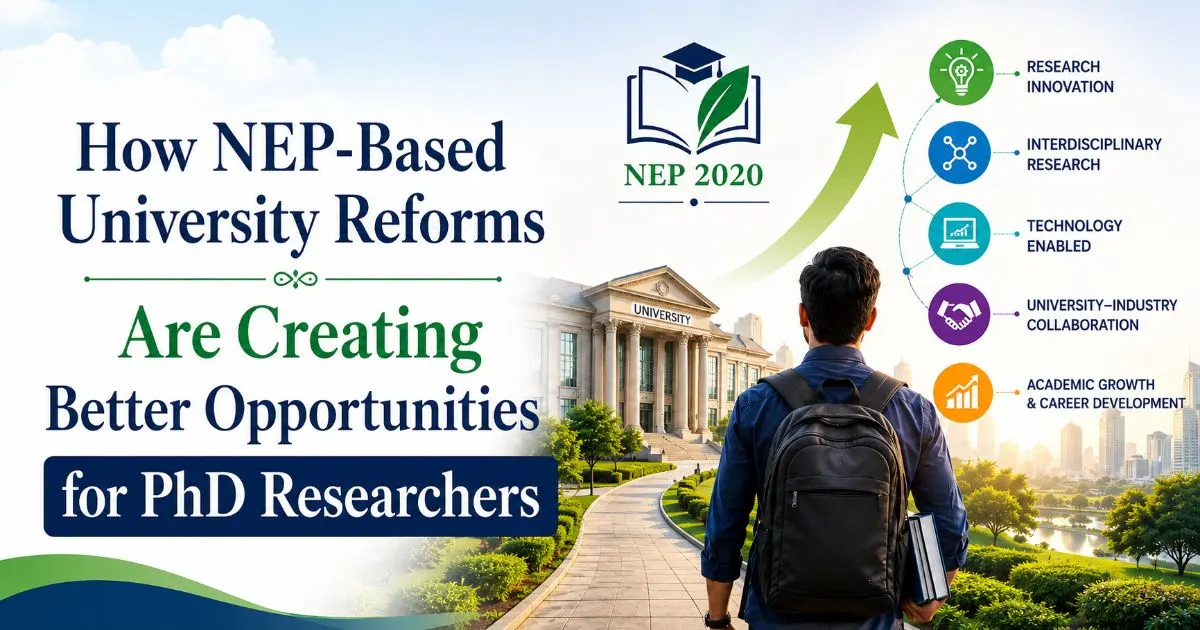
For PhD researchers, National Education Policy -based university reforms can create better opportunities in interdisciplinary research, research innovation, technology-enabled research, university-industry collaboration, academic development and career growth. These changes can help researchers explore wider research areas, work on practical problems, access modern research resources and build skills that remain valuable beyond the PhD.
But what do these reforms actually mean for a PhD researcher? More importantly, how can National Education Policy -based university changes improve your research journey and future opportunities?
The answer becomes clearer when we look at how universities are changing the way research, collaboration, technology, innovation and academic development are approached.
How the National Education Policy Is Changing the PhD Research Environment
The National Education Policy (National Education Policy) 2020 encourages a more flexible, multidisciplinary and research-oriented approach to higher education. For PhD scholars, this can create greater scope to explore research problems that connect different academic areas.
For example, a computer science researcher may explore artificial intelligence in healthcare, agriculture, education or cybersecurity. An engineering researcher may combine technology with renewable energy, environmental studies or management.
This gives researchers an opportunity to think beyond the boundaries of a single subject and focus on important problems that their research can help solve.
Why Interdisciplinary Research Can Benefit PhD Scholars
Many current research challenges involve more than one discipline. Artificial intelligence, healthcare, climate change, cybersecurity, renewable energy and digital transformation often require knowledge from multiple fields.
A multidisciplinary research environment can help PhD scholars:
- Work with researchers from different departments
- Combine knowledge from multiple disciplines
- Explore new research directions
- Apply different methodologies to one problem
- Develop research with wider practical relevance
For researchers, this can create opportunities to build broader expertise while approaching complex problems from different perspectives.
How University Research Can Connect with Industry
Another important opportunity is the connection between university research and practical applications.
Collaboration between universities, industries, research institutions and external organisations can give PhD scholars exposure to real-world research problems, applied projects, technical expertise, practical datasets and innovation activities.
This can be particularly valuable for researchers who want their research to create practical impact rather than remain limited to academic discussion.
A PhD can therefore support career paths beyond traditional teaching roles, including R&D, technology, innovation, consulting and industry research.
What Technology Can Add to PhD Research
Technology is becoming an important part of modern research. PhD scholars may use digital libraries, academic databases, statistical software, programming tools, data-analysis platforms, reference-management systems and online collaboration tools throughout their research journey.
Technology can support a research workflow such as:
Literature Review → Data Collection → Data Analysis → Research Writing → Collaboration → Research Communication
These tools can make research more efficient, but they do not replace academic judgement. Researchers still need to verify information, evaluate evidence, protect research data, maintain originality and follow research ethics.
Why Research Quality Is Becoming More Important
Better research opportunities also come with greater responsibility toward research quality.
A strong PhD profile is not created simply by publishing a large number of papers. Researchers need to demonstrate originality, appropriate methodology, reliable evidence, meaningful findings and a clear contribution to knowledge.
Important areas include:
- Original research questions
- Clear research objectives
- Appropriate methodology
- Reliable data
- Correct analysis
- Ethical research practices
- Meaningful conclusions
- Contribution to existing knowledge
Focusing on these areas can help researchers produce work with genuine academic value and build a stronger research profile.
How Collaboration Can Strengthen a Research Career
PhD research does not have to be an isolated journey.
Working with supervisors, research groups, laboratories, universities, industries and other researchers can introduce scholars to new research perspectives, methodologies and emerging developments.
Conferences, seminars, workshops and research communities can also provide opportunities to communicate research, learn from others and develop academic connections.
For early-stage researchers, these experiences can be useful when identifying research gaps, improving research skills and understanding where their work fits within the wider research community.
What PhD Aspirants Should Look for in a University
National Education Policy-related reforms may not be implemented in exactly the same way by every university. Therefore, PhD aspirants should examine the actual research environment before choosing an institution.
Instead of considering only university reputation or location, check:
- Research area: Does the university support your intended topic?
- Supervisor: Are suitable and experienced supervisors available?
- Research facilities: Are laboratories, databases and relevant tools accessible?
- Research culture: Does the institution actively support research activities?
- Interdisciplinary support: Can you work with other departments?
- Collaboration: Are opportunities available to work with external organisations?
- Career exposure: Does the research environment support future academic or professional opportunities?
Choosing a university based on these factors can make the doctoral journey more productive and relevant.
Which Skills Can Help PhD Researchers Use These Opportunities?
A changing research environment also requires researchers to develop skills beyond subject knowledge.
PhD scholars can benefit from strengthening:
Research Methodology — to design and conduct reliable research.
Academic Writing — to present research clearly and logically.
Data Analysis — to select and apply suitable analytical methods.
Digital Research Skills — to work effectively with research databases and software.
Critical Thinking — to evaluate evidence and identify meaningful research gaps.
Research Communication — to explain findings to academic and non-academic audiences.
Interdisciplinary Collaboration — to work effectively with researchers from different backgrounds.
Developing these skills can help scholars make better use of the research opportunities available in a changing university environment.
How These Changes Can Expand PhD Career Opportunities
A stronger research and innovation environment can expose PhD graduates to a wider range of career possibilities.
Depending on their research area and skills, graduates can explore opportunities in:
- Universities and higher education
- Research institutions
- Corporate R&D
- Technology companies
- Government research organisations
- Consulting
- Innovation centres
- Data and analytics
- Scientific and technical research
Interdisciplinary and practical research experience can be particularly useful for careers where organisations need professionals who can connect specialised knowledge with real-world problems.
What PhD Researchers Should Do Now
National Education Policy-based reforms can create opportunities, but researchers need to make informed decisions to benefit from them.
For PhD aspirants, this means identifying a meaningful research area, studying existing literature, finding genuine research gaps, selecting an appropriate supervisor and evaluating the university's research environment before applying.
For current PhD researchers, it means developing relevant research skills, exploring interdisciplinary collaboration, using technology responsibly, improving research quality and looking for opportunities to connect research with practical problems.
Researchers should also check the latest university-specific rules and programme requirements because implementation can vary between institutions.
So, How Are National Education Policy-Based Reforms Creating Better Opportunities?
National Education Policy-based university reforms are encouraging a more flexible, multidisciplinary, research-focused and innovation-oriented environment.
For PhD researchers, this can create greater opportunities to:
- Explore interdisciplinary research topics
- Work on practical and relevant problems
- Use modern research technologies
- Collaborate with researchers and external organisations
- Develop stronger research skills
- Build wider academic and professional networks
- Explore career opportunities beyond traditional academic roles
The actual opportunities available will depend on the university, programme, research area and level of implementation. Therefore, researchers should evaluate these factors carefully rather than assuming that every institution will provide the same experience.