

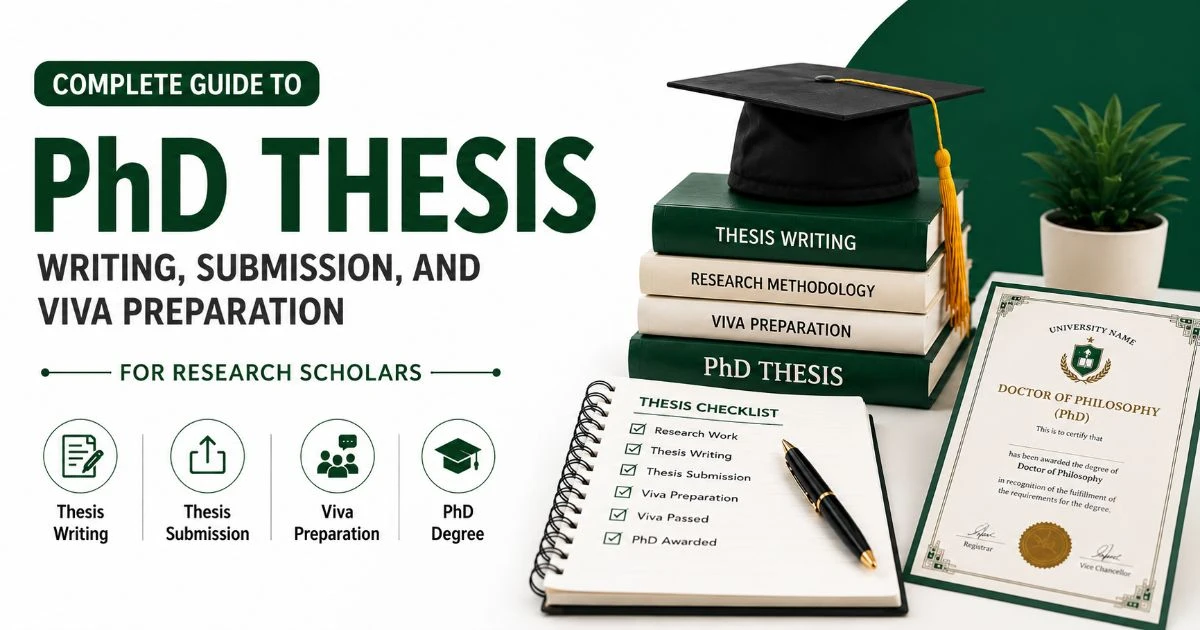
Completing research is a major milestone, but for many PhD scholars, the final stage of the doctoral journey is often the most challenging. PhD thesis writing, thesis submission, and viva preparation require careful planning, academic precision, and a clear understanding of university requirements. Even high-quality research can face delays due to formatting errors, incomplete documentation, or inadequate viva preparation.
This complete guide explains every stage of PhD thesis writing, submission, and viva preparation in a simple and practical way. You'll learn how to write a well-structured thesis, prepare for a smooth submission process, avoid common mistakes, and confidently defend your research during the viva examination.
What is PhD Thesis Writing, Submission, and Viva Preparation?
Before beginning the final stages of a doctoral program, it is important to understand how PhD thesis writing, thesis submission, and viva preparation are connected. These three stages represent the culmination of years of research and determine whether a scholar successfully completes the PhD journey.
- PhD Thesis Writing involves documenting original research in a structured academic format, including the research problem, literature review, methodology, analysis, results, discussion, and conclusion.
- Thesis Submission is the formal process of preparing the thesis according to university guidelines, completing plagiarism checks, verifying references, and submitting all required documents for evaluation.
- PhD Viva Preparation focuses on confidently explaining and defending your research before a panel of examiners by demonstrating your understanding of the research objectives, methodology, findings, and overall contribution.
Understanding these three stages early helps research scholars plan effectively, avoid common mistakes, and complete their doctoral degree with confidence.
Why PhD Thesis Writing Matters
A PhD thesis is more than a lengthy academic document. It demonstrates your ability to conduct original research, solve meaningful problems, and contribute valuable knowledge to your field.
A high-quality PhD thesis writing process should focus on:
- Present a clear research problem
- Explain the research methodology logically
- Provide reliable analysis and results
- Discuss findings with evidence
- Highlight the originality and contribution of the research
- Meet university formatting and submission guidelines
Your thesis becomes a permanent academic record of your research. Therefore, clarity, accuracy, and organization are just as important as the research itself.
Understanding the Three Final Stages of a PhD
Many scholars assume thesis writing is the final step. In reality, the process consists of three equally important stages:
Stage 1: Thesis Writing
PhD thesis writing involves organizing years of research into a structured academic document that clearly presents your research contribution.
Typical chapters include:
- Introduction
- Literature Review
- Research Gap
- Objectives
- Research Methodology
- Data Collection
- Analysis and Results
- Discussion
- Conclusion
- Future Scope
- References
- Appendices
Each chapter should build naturally on the previous one while maintaining a logical flow.
Stage 2: Thesis Submission
Once writing is complete, scholars must prepare the thesis according to university regulations.
This generally includes:
- Formatting verification
- Citation checking
- Plagiarism report
- Synopsis (if required)
- Certificates
- Declaration forms
- Publication proof (where applicable)
- Hardbound and digital copies
Small administrative mistakes can delay submission, even when the research is complete.
Stage 3: Viva Preparation
The viva is not just an oral examination it is an opportunity to defend your research and demonstrate your expertise.
During the viva, examiners typically assess:
- Your understanding of the research problem
- Why you selected your methodology
- Interpretation of results
- Practical significance of your findings
- Research limitations
- Future research opportunities
Preparation significantly improves confidence and performance.
Step-by-Step Guide to Writing a High-Quality PhD Thesis
1. Begin with a Clear Research Story
Instead of treating each chapter independently, think of your thesis as one continuous research journey.
Your thesis should answer questions such as:
- What problem exists?
- Why is it important?
- What solution did you investigate?
- What did your research discover?
- Why do the findings matter?
When every chapter contributes to answering these questions, the thesis becomes much easier to read.
2. Write One Chapter at a Time
Trying to complete PhD thesis writing all at once often leads to frustration and unnecessary stress.
A practical approach is:
- Complete one chapter
- Revise it thoroughly
- Verify references
- Obtain supervisor feedback
- Then move to the next chapter
Breaking the work into manageable sections improves quality and reduces stress.
3. Support Every Claim with Evidence
Academic writing requires evidence rather than assumptions.
Instead of writing:
"Machine learning improves healthcare."
A stronger statement would explain:
- Which machine learning technique?
- In which healthcare application?
- According to which published studies?
- How does your research support or extend existing findings?
Evidence strengthens academic credibility.
4. Maintain Consistent Academic Writing
Consistency improves readability.
Maintain consistency in:
- Terminology
- Figures
- Tables
- Citation style
- Heading hierarchy
- Numbering
- Formatting
Consistency is one of the most important aspects of PhD thesis writing, as it improves readability and maintains academic quality throughout the document.
Essential Components of a Strong PhD Thesis
Introduction
Clearly define:
- Research background
- Problem statement
- Objectives
- Scope
- Significance
Readers should understand the purpose of your research within the first few pages.
Literature Review
A literature review should not simply summarize previous studies.
Instead, explain:
- Existing knowledge
- Research trends
- Conflicting findings
- Limitations
- Research gap
This naturally justifies your research contribution.
Research Methodology
Explain:
- Research design
- Data collection
- Sample selection
- Tools used
- Validation techniques
Readers should be able to understand exactly how your research was conducted.
Results and Discussion
Present findings objectively.
Then explain:
- Why the results occurred
- Comparison with previous studies
- Practical implications
- Research contribution
Interpretation is just as important as presenting data.
Conclusion
A strong conclusion should summarize:
- Objectives achieved
- Major findings
- Contributions
- Limitations
- Recommendations
- Future research directions
Avoid introducing entirely new concepts here.
PhD Thesis Writing Checklist
Before moving to the submission stage, ensure your thesis is complete by checking the following:
- Research problem clearly defined
- Objectives are measurable
- Literature review identifies the research gap
- Methodology is explained in detail
- Results are presented accurately
- Discussion compares findings with previous studies
- Conclusion answers the research objectives
- References follow the required citation style
- Grammar and formatting have been reviewed
- Plagiarism has been checked
Completing this checklist improves both the quality of your thesis and your readiness for submission.
PhD Thesis Submission Checklist
Before submitting your PhD thesis, make sure you've completed these essential checks:
- Follow your university's thesis formatting guidelines.
- Verify page numbering, headings, tables, and figures.
- Ensure all citations and references are accurate and properly formatted.
- Ensure your plagiarism report meets university requirements.
- Attach all required certificates and declaration forms.
- Prepare the required hardbound and digital copies.
- Review the entire thesis for grammar, formatting, and spelling errors.
A final review before submission can help you avoid unnecessary revisions and ensure a smooth evaluation process.
How to Prepare for Your PhD Viva
Many scholars worry about unexpected questions. In reality, most viva questions focus on your own research.
Review Every Chapter
Be prepared to explain:
- Why the study was conducted
- Why the methodology was selected
- How data was analyzed
- How conclusions were reached
A thorough understanding of your research makes it easier to answer viva questions with confidence.
Practice Explaining Your Research Simply
Imagine explaining your research to someone outside your specialization.
If you can communicate complex ideas clearly, you are more likely to answer confidently during the viva.
Prepare for Common Examiner Questions
Examples include:
- Why did you choose this research topic?
- What research gap did you identify?
- Why was this methodology appropriate?
- What are your key contributions?
- What limitations exist?
- How can future researchers extend this work?
Preparing structured answers reduces anxiety.
Practical Example
Consider a scholar researching AI-based crop disease detection.
A strong viva response might explain:
- Why agriculture was selected
- Problems farmers currently face
- Why image classification was appropriate
- Dataset selection
- Model evaluation
- Accuracy improvements over previous studies
- Practical benefits for farmers
This approach demonstrates understanding rather than memorization.
Examples of PhD Thesis Topics Across Different Research Fields
|
Research Area |
Example Thesis Topic |
|
Computer Science |
AI-Based Intrusion Detection System |
|
Electronics and Communication Engineering |
IoT-Based Smart Healthcare Monitoring |
|
Electrical Engineering |
Renewable Energy Optimization Using Machine Learning |
|
Mechanical Engineering |
Hybrid Manufacturing Process Optimization |
|
Civil Engineering |
Sustainable Construction Materials for Smart Infrastructure |
|
Pharmacy |
Nanoparticle Drug Delivery Systems |
|
Biotechnology |
CRISPR Applications in Crop Improvement |
|
Management |
Digital Consumer Behaviour in E-Commerce |
These examples demonstrate how the same thesis structure can be adapted to different academic disciplines while addressing unique research challenges.
One-Week PhD Viva Preparation Plan
A structured preparation schedule can significantly improve your confidence before the viva examination.
7 Days Before
- Review the entire thesis.
- Revise research objectives and hypotheses.
5 Days Before
- Practice explaining your methodology and research findings.
3 Days Before
- Review important references and related research papers.
2 Days Before
- Conduct a mock viva with your supervisor or colleagues.
1 Day Before
- Organize your documents, revise key contributions, and get sufficient rest.
Consistent preparation allows you to answer examiner questions with greater clarity and confidence.
Common Mistakes Research Scholars Should Avoid
Even well-conducted research can face delays due to avoidable mistakes. Identifying and addressing these issues early can help you complete your PhD thesis writing, submission, and viva preparation with greater confidence and ease.
- Ignoring university guidelines – Always follow your university's thesis formatting and submission requirements.
- Choosing a weak research problem – A clearly defined research problem lays the foundation for a strong thesis.
- Writing an incomplete literature review – Identify the research gap and critically analyze previous studies.
- Using incorrect citations and references – Ensure every source is cited accurately using the required citation style.
- Skipping plagiarism checks – Review your similarity report, address any plagiarism concerns, and ensure academic integrity before submission.
- Ignoring supervisor feedback – Regularly incorporate suggestions to strengthen your thesis.
- Rushing proofreading – Check for grammar, formatting, spelling, and consistency before final submission.
- Preparing for the viva at the last minute – Start your viva preparation early and practice answering common examiner questions.
Avoiding these common mistakes can enhance the quality of your thesis, streamline the submission process, and boost your confidence for the PhD viva.
Expert Tips for Successful Thesis Writing, Submission, and Viva
- Start writing while research is ongoing instead of waiting until the end.
- Create weekly writing goals instead of relying on deadlines alone.
- Maintain a reference library using citation management software.
- Back up your thesis regularly using secure cloud storage.
- Review university submission guidelines before formatting.
- Conduct mock viva sessions with mentors or colleagues.
- Practice answering questions confidently rather than memorizing scripts.
- Treat examiner feedback as an opportunity to demonstrate your expertise.
Need Professional Guidance for Your PhD Thesis?
Many research scholars seek expert support when they face challenges such as:
- Thesis organization
- Literature review development
- Research methodology writing
- Data interpretation
- Thesis editing and proofreading
- Plagiarism reduction guidance
- University formatting
- Thesis submission documentation
- Viva preparation and mock sessions
Professional academic guidance can help scholars avoid unnecessary delays while maintaining academic integrity and university standards.
Final Thoughts
Completing a PhD is not just about conducting meaningful research it is about presenting that research effectively, meeting submission requirements, and confidently defending your work during the viva. By planning each stage carefully, following university guidelines, and seeking timely guidance when needed, you can make the transition from researcher to doctoral graduate much smoother.
If you're looking for expert support with PhD thesis writing, submission, or viva preparation, professional guidance can help you strengthen your research presentation, avoid common pitfalls, and move toward successful degree completion with confidence.