

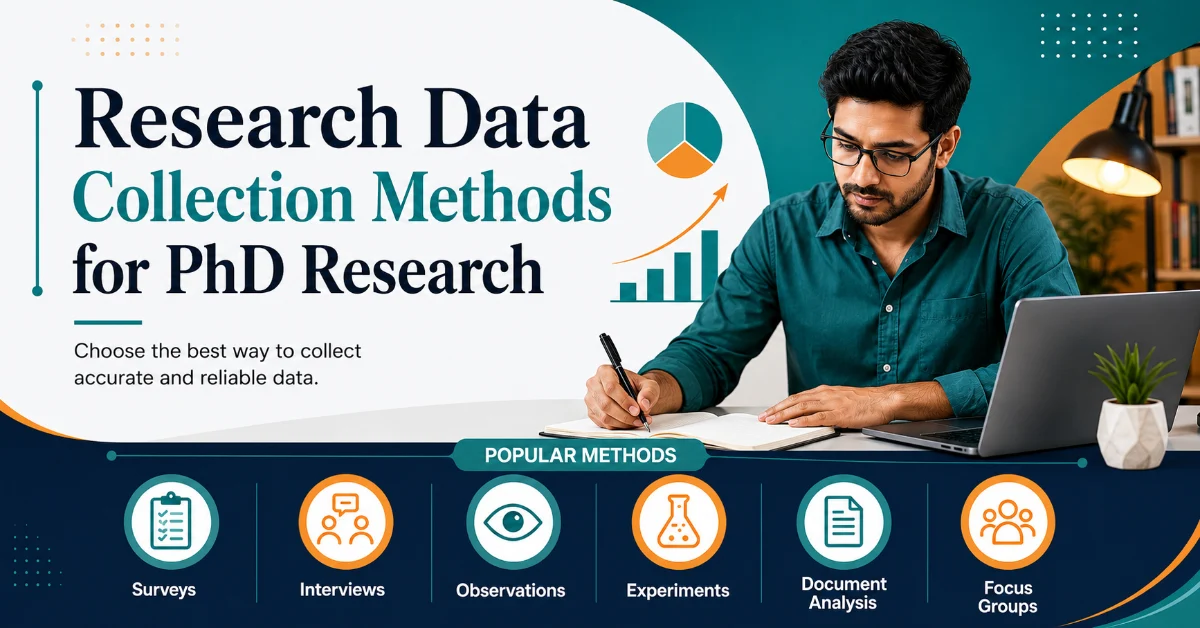
Introduction: Choosing the Right Data Collection Method Can Shape Your Research Success
Imagine spending months identifying a research gap, writing a detailed proposal, and getting your supervisor's approval only to realize that the data you collected cannot answer your research questions effectively. This is a common challenge faced by many PhD scholars. One of the biggest reasons is selecting inappropriate Research Data Collection Methods without fully understanding their purpose, strengths, and limitations.
No matter your research field, the quality of your findings depends on the quality of the data you collect. Choosing between surveys, interviews, questionnaires, observations, experiments, or secondary data directly affects the accuracy, validity, and credibility of your research.
This guide explains the most effective Research Data Collection Methods used in PhD research with practical examples, helping you understand when to use each method and make informed decisions throughout your research journey.
What Is Research Data Collection and Why Does It Matter?
Research Data Collection Methods are systematic approaches used to gather accurate and relevant information for answering research questions or testing hypotheses. The quality of your research findings depends on choosing the right method to collect reliable data.
In simple terms, data collection involves gathering evidence that supports your research objectives. The method should match your research problem, study design, and target population to ensure accurate and meaningful results.
For example, surveys are useful for collecting data from large groups, while interviews help researchers explore experiences and opinions in greater depth. Choosing the right Research Data Collection Method improves research quality, reduces bias, and strengthens the credibility of your PhD study.
Why Choosing the Right Data Collection Method Can Make or Break Your Research?
Every stage of a research project depends on accurate information. Even a well-written proposal or an innovative research topic cannot produce meaningful results if the collected data is incomplete or unreliable.
Effective data collection helps researchers:
- Collect reliable evidence to answer research questions.
- Improve the validity and credibility of research findings.
- Support statistical analysis and interpretation.
- Minimize errors and research bias.
- Strengthen thesis quality and academic publications.
- Build confidence during thesis evaluation and viva voce examinations.
For instance, a PhD scholar evaluating employee engagement cannot rely solely on assumptions. Collecting responses directly from employees through validated questionnaires provides measurable evidence that supports meaningful conclusions.
Main Types of Research Data Collection Methods
Research data is generally collected using two approaches: Primary Data Collection and Secondary Data Collection. The right choice depends on your research objectives, methodology, and the type of information you need.
Primary Data Collection
Primary data is original information collected directly by the researcher for a specific study. It is accurate, relevant, and designed to meet the research objectives.
Common methods include:
- Surveys
- Questionnaires
- Interviews
- Observations
- Focus Group Discussions
- Experiments
Example: A researcher conducts an online survey to understand consumer buying behaviour.
Secondary Data Collection
Secondary data is information that has already been collected by researchers, organizations, or government agencies. It is useful for literature reviews, background research, and trend analysis.
Common sources include:
- Research journals
- Scopus and IEEE publications
- Government reports
- Census data
- Books
- Academic databases
Example: A researcher analyzes government reports to study renewable energy trends.
Primary vs Secondary Data Collection
|
Feature |
Primary Data |
Secondary Data |
|
Source |
Collected by the researcher |
Existing sources |
|
Cost |
Higher |
Lower |
|
Time |
More |
Less |
|
Accuracy |
Highly specific |
Depends on the source |
|
Best For |
Original research |
Background research and literature review |
Many PhD researchers combine both methods to achieve more reliable and comprehensive results.

Primary Research Data Collection Methods with Examples
Primary research data is collected directly by the researcher to answer a specific research question. It provides accurate, relevant, and up-to-date information that matches the research objectives.
The most common primary research data collection methods are surveys, questionnaires, interviews, observations, focus group discussions, and experiments.
1. Surveys
Surveys are one of the most widely used Research Data Collection Methods. They help researchers collect information from a large number of participants quickly and are ideal for quantitative research.
Advantages
- Covers large sample sizes
- Cost-effective
- Easy to analyze
Limitations
- Low response rates
- Limited detailed responses
- Response bias
Example: A researcher surveys 1,000 employees to measure workplace satisfaction.
2. Questionnaires
A questionnaire is a structured set of questions used to collect standardized information from participants. It is commonly used in surveys to gather consistent and reliable data.
Common Question Types
- Multiple-choice
- Rating scales
- Likert scales
- Open-ended questions
Advantages
- Easy to distribute
- Produces consistent data
- Saves time
Limitations
- Questions may be misunderstood
- Limited clarification
- Poor design affects results
Example: A PhD researcher distributes questionnaires to study customer satisfaction.
3. Interviews
Interviews involve direct interaction between the researcher and participants to collect detailed opinions, experiences, and insights. They are widely used in qualitative research.
Types of Interviews
- Structured
- Semi-structured
- Unstructured
Advantages
- Detailed information
- Allows follow-up questions
- Provides deeper insights
Limitations
- Time-consuming
- Requires communication skills
- Difficult to analyze
Example: A researcher interviews university professors to understand AI adoption in higher education.
4. Observation Method
Observation involves watching people, events, or activities in their natural environment to collect real-time data. It is useful for studying actual behaviour without relying only on participant responses.
Types of Observation
- Participant Observation
- Non-Participant Observation
Advantages
- Captures real behaviour
- Reduces response bias
- Suitable for field research
Limitations
- Time-consuming
- Observer bias
- Ethical concerns
Example: A researcher observes classroom activities to evaluate student engagement.
5. Focus Group Discussions
Focus group discussions involve a small group of participants sharing their opinions under the guidance of a moderator. This method helps researchers understand different perspectives and experiences.
Advantages
- Collects diverse opinions
- Encourages discussion
- Provides valuable insights
Limitations
- Requires skilled moderation
- Some participants may dominate
- Difficult to analyze
Example: A healthcare researcher conducts a focus group with nurses to discuss electronic health record implementation.
6. Experiments
Experiments help researchers identify cause-and-effect relationships by testing variables under controlled conditions. They are commonly used in engineering, science, medicine, and agriculture.
Advantages
- Supports hypothesis testing
- Produces measurable results
- High research accuracy
Limitations
- Can be expensive
- Ethical approval may be required
- Controlled settings may not reflect real situations
Example: An engineering researcher compares two machine learning models to improve fault detection accuracy.
Common Sources of Secondary Data
Secondary data is information that has already been collected and published by researchers, organizations, government agencies, or other reliable sources. It is especially useful during literature reviews, trend analysis, and comparative research.
Reliable secondary data sources include:
- Books
- IEEE research papers
- Scopus-indexed journals
- Government reports
- Census databases
- Company annual reports
- Institutional publications
- Online research repositories
Before using secondary data, researchers should evaluate its credibility, publication date, relevance, and authenticity.
Example:
A researcher studying electric vehicle adoption analyzes government transportation reports and IEEE journal articles instead of conducting nationwide surveys.
Which Research Data Collection Method Should You Choose?
Choosing the right Research Data Collection Method depends on your research objectives and the type of data you need. The table below provides a quick reference to help you select the most suitable method.
|
Research Objective |
Recommended Method |
|
Customer Satisfaction |
Survey |
|
Employee Motivation |
Questionnaire |
|
Consumer Behaviour |
Interview |
|
Classroom Behaviour |
Observation |
|
Healthcare Opinions |
Focus Group Discussion |
|
Engineering Testing |
Experiment |
|
Historical Research |
Secondary Data Analysis |
Factors to Consider Before Choosing a Data Collection Method
Selecting the appropriate Research Data Collection Methods depends on your research objectives rather than personal preference. Asking the following questions before collecting data can help you make the right decision.
Define Your Research Objectives
Clearly identify what you want to investigate. Different objectives require different methods.
Identify Your Target Population
Determine who will provide the information, such as students, employees, patients, customers, or industry experts.
Choose the Appropriate Data Type
- Qualitative research explores experiences and opinions.
- Quantitative research measures numerical data.
- Mixed-method research combines both approaches.
Consider Resources
Evaluate your available budget, timeline, software, travel requirements, and manpower before selecting a method.
Follow Ethical Guidelines
Follow ethical research practices by obtaining informed consent, protecting participant confidentiality, and complying with institutional guidelines.
Choosing a method that aligns with these factors improves research quality and reduces unnecessary challenges during data collection.
Common Mistakes Researchers Should Avoid
Avoid these common mistakes during data collection:
- Choosing the wrong method
- Using unclear questionnaires
- Selecting a small sample size
- Ignoring ethical approval
- Asking biased questions
- Skipping pilot testing
- Failing to verify collected data.
Best Practices for Effective Data Collection
To improve research quality:
- Define clear objectives.
- Select the right data collection method.
- Conduct a pilot study.
- Use validated research tools.
- Keep accurate records.
- Protect participant confidentiality.
- Verify data before analysis.
- Follow ethical research practices.
Conclusion
Selecting the right Research Data Collection Methods is one of the most important decisions in any PhD research project. Every method whether surveys, questionnaires, interviews, observations, experiments, or secondary data analysis serves a specific purpose and should align with your research objectives, study design, and target population. By understanding the strengths and limitations of each approach, researchers can collect reliable evidence, minimize bias, and produce credible findings that contribute to academic knowledge.
If you are planning your doctoral research and need support with research methodology, questionnaire design, sampling strategies, or data analysis, seeking guidance from experienced research mentors can simplify the process and help you complete your thesis with greater confidence and academic quality.
Need Help with Research Data Collection for Your PhD?
Choosing the right research methodology, data collection method, and data analysis approach is essential for successful PhD research. If you need assistance with research methodology, questionnaire design, sampling strategies, statistical analysis, journal publication, or thesis writing, Takeoff PhD Guidance is here to support you at every stage.
Contact Takeoff PhD Guidance today for personalized research support and complete your PhD journey with confidence.