Completing a research study is an important achievement, but presenting its findings in a clear and publishable format requires a different set of skills. Many researchers understand their research topic and results but struggle to organise the information, explain their methodology, present findings and develop a strong discussion. A well-prepared manuscript helps readers understand what was studied, how the research was conducted, what was discovered and why the findings matter. This guide explains how to approach manuscript writing step by step, structure each section and avoid common mistakes before preparing a research paper for journal submission.
Quick Answer: How Do You Write a Research Manuscript?
To write a research manuscript, first identify your study's main contribution and organise your research findings. Then prepare the manuscript using a structure appropriate for your research type. For a typical original research article, this commonly includes a title, abstract, introduction, methodology, results, discussion and conclusion. Present evidence accurately, support statements with relevant references, follow the target journal's author guidelines and revise the complete document for clarity and consistency.
What Is Research Manuscript Writing?
Research manuscript writing is the process of presenting an original study, its methodology, findings and contribution in a structured academic document. It allows researchers to communicate their work to other scholars, subject experts and the wider research community.
A manuscript should do more than describe the research activities. It should explain:
- Research problem: What issue or question does the study address?
- Research gap: What limitation or unanswered question exists in previous studies?
- Research approach: How was the investigation conducted?
- Research findings: What did the study discover?
- Research contribution: How do the findings add to existing knowledge?
A strong manuscript connects these elements logically so readers can understand the purpose, process and significance of the research.
Before Writing: Organise Your Research Information
Starting with the first paragraph is not always the most effective approach. Before drafting, organise the essential information from your completed research. This reduces repetition and helps maintain consistency across sections.
|
Research element |
Information to prepare |
|
Research problem |
The specific issue investigated |
|
Research gap |
What previous studies have not sufficiently addressed |
|
Objectives |
What the study intended to achieve |
|
Methodology |
Research design, data sources, participants, tools and procedures |
|
Analysis |
Methods used to examine the collected data |
|
Findings |
The main results supported by evidence |
|
Contribution |
What the study adds to the subject area |
Also organise your research notes, datasets, tables, figures and reference list. Verify important figures and citations against the original sources before including them.
Practical tip: Researchers do not have to write every manuscript section in the order in which it appears. Many find it easier to draft the methodology and results first, then develop the introduction and discussion, and prepare the abstract and final title after the manuscript becomes clearer.
How to Structure a Research Manuscript
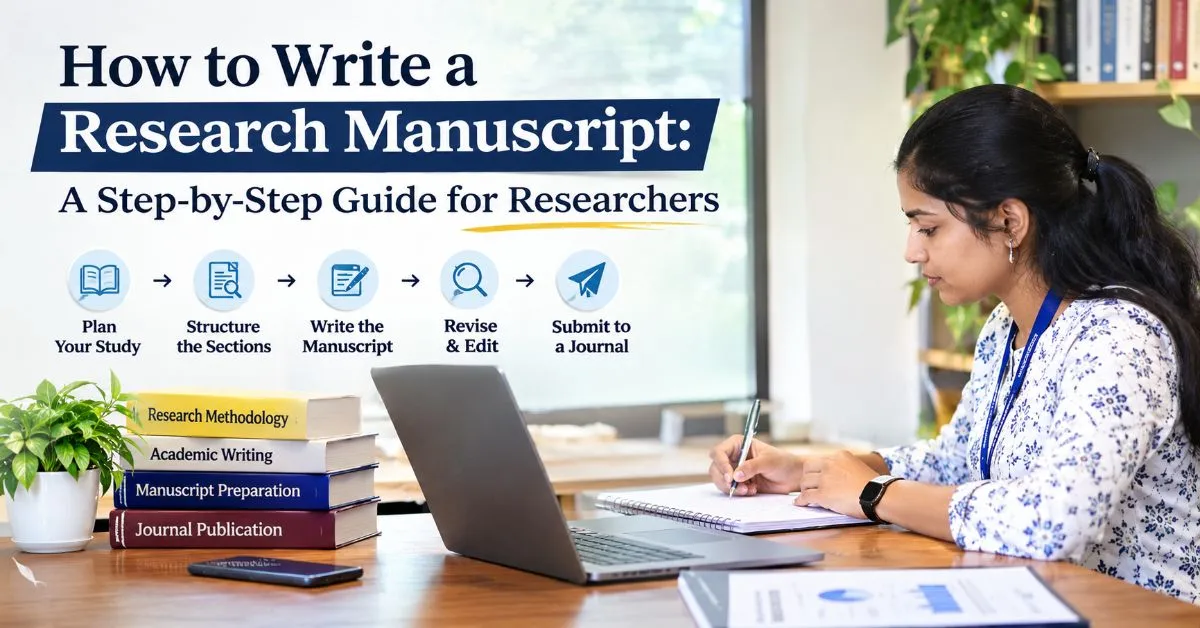
A research manuscript should present your study in a clear and logical order. Many original research articles follow the IMRAD format: Introduction, Methods, Results and Discussion. The complete structure may also include a title, abstract, conclusion and references, depending on the journal and research type.
1. Write a Clear Research Title
Your title should briefly explain what your study investigates. Include the main topic, important variables or research context where relevant.
Example:
- General: A Study on Student Performance
- Specific: Factors Influencing Academic Performance Among Undergraduate Engineering Students
Choose a title that accurately represents your research. Avoid vague words and unnecessary abbreviations.
2. Prepare a Focused Abstract
An abstract briefly presents your research so readers can understand the study quickly.
Include these five elements:
- Background: What research problem did you address?
- Objective: What did the study aim to achieve?
- Methods: How was the research conducted?
- Results: What were the main findings?
- Conclusion: What do the findings indicate?
Write the abstract after completing the main sections and follow the journal's word limit and format.
3. Develop the Introduction
The introduction explains why your research is important and what problem it addresses.
Include:
- Research background: Introduce the topic.
- Problem statement: Explain the issue being investigated.
- Research gap: Identify what previous studies have not sufficiently addressed.
- Research objectives: State what your study aims to examine.
- Research contribution: Explain what your study adds to existing knowledge.
Keep the introduction focused on your research problem rather than including unrelated literature.
4. Explain the Research Methodology
The methodology describes how you conducted your research. Include the details relevant to your study:
- Research design: Qualitative, quantitative, experimental or mixed-methods.
- Population and sample: Who or what was studied.
- Sampling procedure: How participants or data were selected.
- Data collection: How information was gathered.
- Research tools: Questionnaires, software, instruments or interview guides.
- Data analysis: Statistical tests or qualitative analysis methods.
- Ethical considerations: Approval and consent details, where applicable.
Report only the methods you actually used so readers can understand and evaluate your research.
5. Present the Research Results
The Results section presents your actual findings in a clear and organised manner.
Depending on your research type, include:
- Quantitative research: Frequencies, percentages, averages, statistical tests and relevant results.
- Qualitative research: Themes, patterns and supporting participant evidence.
Use tables and figures when they make findings easier to understand. Keep interpretations for the Discussion section.
6. Write the Discussion
The Discussion explains what your findings mean and how they relate to previous research.
Focus on:
- Explaining the main findings.
- Comparing results with earlier studies.
- Discussing similarities and differences.
- Identifying academic or practical implications.
- Acknowledging research limitations.
Avoid repeating the Results section or making claims that your evidence cannot support.
7. Prepare a Meaningful Conclusion
The conclusion summarises the research and answers its main objectives.
Include:
- The most important findings.
- The answer to your research question.
- The research contribution.
- Relevant future research directions.
Do not introduce new findings or unsupported claims. Keep the conclusion consistent with your results.
How Does Manuscript Structure Differ by Research Type?
Not every research paper follows exactly the same structure. The organisation should reflect the purpose and methods of the investigation.
|
Research type |
Common structural focus |
|
Quantitative research |
Variables, hypotheses, measurements, statistical analysis and results |
|
Qualitative research |
Research context, participants, data collection, themes and interpretation |
|
Experimental research |
Experimental design, materials, procedures, measurements and outcomes |
|
Systematic review |
Review question, search strategy, eligibility criteria, study selection and synthesis |
|
Theoretical research |
Concepts, theoretical framework, arguments and critical analysis |
For example, a systematic review may require a detailed search strategy and study-selection process, while an experimental paper may need a detailed description of equipment and procedures. Always use a structure suitable for the research design and follow the journal's instructions.
How to Prepare Tables, Figures and References
Tables and figures help readers understand complex research information more easily. Use them when they communicate findings more clearly than lengthy paragraphs.
Tables: Present numerical information, comparisons and detailed results in an organised format. Give each table a clear number and descriptive title.
Figures: Use graphs, diagrams, charts or images when they help explain patterns, processes or research outcomes. Ensure labels, legends and captions are understandable.
References: Cite the original sources that support your background, methods and discussion. Use the citation style required by the target journal and verify that every in-text citation has a corresponding reference-list entry.
Do not duplicate the same information unnecessarily in the text, tables and figures. Every visual element should contribute to understanding the research.
Common Manuscript Writing Mistakes to Avoid
Even strong research can be difficult to assess if the manuscript lacks clarity or consistency. Watch out for these common problems:
- Unclear research objectives: Readers cannot understand what the study intended to investigate.
- Weak research gap: The introduction does not explain why the study was necessary.
- Insufficient methodology: Important details about data collection or analysis are missing.
- Mixing results and discussion: Findings are not clearly separated from their interpretation when the journal requires separate sections.
- Unsupported conclusions: Claims extend beyond the evidence collected.
- Inconsistent references: Citations are missing, inaccurate or formatted incorrectly.
- Unnecessary repetition: The same explanations appear in multiple sections.
- Ignoring journal guidelines: The manuscript does not follow the required structure, formatting or word limits.
Reviewing these issues before submission can improve clarity and reduce avoidable editorial problems.
Practical Tips to Improve Your Manuscript Before Submission
Use these simple tips to make your research manuscript clearer, more professional and easier to review.
- Maintain Clear Language: Use simple, precise academic language and avoid unnecessarily complex sentences.
- Keep Your Writing Consistent: Use the same terminology, abbreviations and academic tone throughout the manuscript.
- Ensure Logical Flow: Connect each section so readers can understand how your research progresses from the problem to the findings.
- Focus on Research Relevance: Make sure every paragraph supports your research objectives and contributes to the main discussion.
- Review for Clarity: Read the manuscript from a reader's perspective and rewrite unclear or lengthy explanations.
- Use AI Tools Carefully: If journal policies permit, use AI tools for language improvement, but verify all information and maintain research originality.
Final Manuscript Readiness Checklist
Before submitting your research manuscript, check these 10 points:
- Does the title clearly represent your research?
- Does the abstract accurately summarise the study?
- Are the research problem, gap and objectives clearly explained?
- Is the methodology consistent with the actual research?
- Are all findings supported by the original data?
- Does the discussion explain the significance of the results?
- Does the conclusion address the research objectives?
- Are tables, figures and references accurate?
- Have grammar, formatting and citations been reviewed?
- Does the manuscript follow the target journal's author guidelines?
Conclusion: Prepare a Research Manuscript with Clarity and Confidence
A strong research manuscript presents a clear research problem, explains the methodology accurately, reports findings objectively and demonstrates the contribution of the study. Each section should connect logically with the next so readers can understand both the research process and its significance.
Careful planning, accurate reporting, relevant references and thorough revision are essential parts of effective manuscript writing. If you need support with research organisation, academic writing, methodology or preparing your research findings for presentation, expert guidance can help you identify areas that need improvement.
Need guidance with your research manuscript?
Explore Takeoff PhD Guidance for academic support with research development, journal paper writing, thesis preparation and publication-related requirements. You can also book a free PhD consultation to discuss your research requirements.